A wheel rolls its circumference in one turn: π × diameter, a little more than three times the distance across it. As the wheel turns once, every point on its edge touches the floor once, so the whole edge gets laid out along the ground. A 56 mm wheel rolls π × 56 ≈ 176 mm, about 17.6 cm, per turn.
That one fact explains why big wheels make a car go further for the same number of turns, how a car’s odometer counts distance, and how to measure a wheel you can’t read the size of. Try it with three wheel sizes from our builds first.
Interactive: Wheel roll lab. Pick a 30.4, 43.2 or 56 mm wheel and a number of turns and watch how far it rolls: π × diameter per turn. Five predict-then-check questions use the Big-Wheel Dragster, Pull-back Racer, Push Buggy and Odometer Cart.
The three wheels
The sizes are in the parts’ official names: a “Wheel 56 x 26” is 56 mm across and 26 mm wide. Here they are with what one turn should roll:
| Wheel | Diameter | One turn rolls | Used on |
|---|---|---|---|
| Small white wheel | 30.4 mm | about 9.6 cm | Pull-back Racer |
| Yellow-hub wheel | 43.2 mm | about 13.6 cm | Push Buggy |
| Big tyre wheel | 56 mm | about 17.6 cm | Big-Wheel Dragster, Odometer Cart |
Three mistakes to watch for
Using the diameter instead of the circumference. One turn rolls more than three diameters, not one. Dividing a distance by the diameter gives three times too many turns.
Mixing up radius and diameter. The circumference is π × diameter, or 2 × π × radius. Multiply the *diameter* by 2π and you get double the real answer.
Thinking size grows faster than it does. A wheel twice as wide across rolls twice as far per turn, not four times. Four times is how much its face area grows, which has nothing to do with rolling.
Why the Big-Wheel Dragster goes further
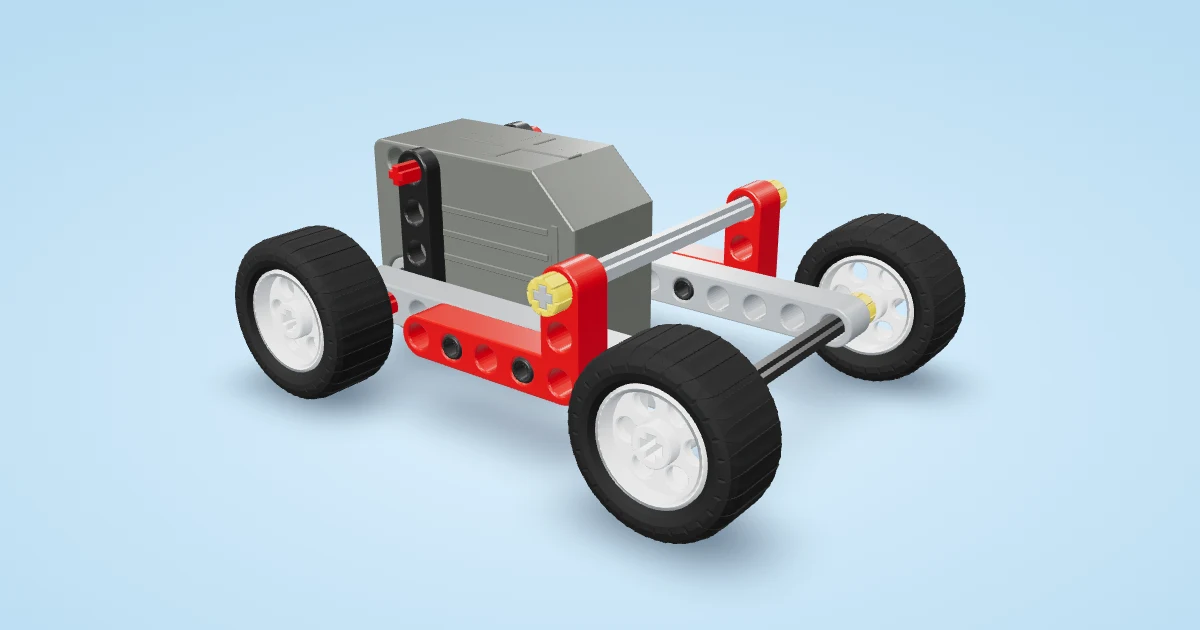
The Big-Wheel Dragster is a level 2 build of about 22 minutes, 30 parts in 10 steps. Its pull-back motor sits on the axle of two big 56 mm wheels, with small 30.4 mm wheels at the front. Its instructions point out that one turn of a big wheel rolls about 18 cm against about 9 cm for a small one, and call the big wheels a “high gear”: more distance for every turn of the spring.
So if the spring turns the back axle the same number of times, the dragster should roll 56 ÷ 30.4 ≈ 1.8 times as far as the Pull-back Racer on its small wheels. The instructions say it goes almost twice as far. The catch, as with any high gear, is less push at the floor, so a heavy car or a carpet can stop it sooner. What is torque? explains that trade, and the pull-back car experiment shows how to test it fairly.
Counting distance with turns
Count turns and you can measure distance. The Odometer Cart does it with gears: an 8-tooth gear on its axle turns a 40-tooth gear, so its red flag goes round once every five wheel turns. Five turns of a 56 mm wheel is about 88 cm (the instructions round it to 90 cm), so each flag turn is a little under a metre. Real car odometers work on the same idea. A rack does the same job in a straight line: how far does a rack move counts teeth instead of turns.
The worksheet
Print this table or copy it into a notebook. You need a ruler or tape measure, a piece of tape to mark one spot on the tyre, and a strip of paper or a chalk line on the floor.
- Mark one spot on the tyre and stand the wheel with the mark touching the start line.
- Roll it in a straight line for exactly 5 turns, pressing down gently, until the mark touches the floor again.
- Measure the distance and divide by 5 to get one turn.
- Work out π × diameter and compare.
| Wheel | Diameter (mm) | Predicted one turn (π × d) | Measured 5 turns | Measured one turn | Difference |
|---|---|---|---|---|---|
| Small white | 30.4 | ||||
| Yellow-hub | 43.2 | ||||
| Big tyre | 56 | ||||
| My own wheel |
If your measured turn comes out a little short, that is real: a rubber tyre can flatten slightly where it presses on the floor and act like a smaller wheel. Try pressing harder, or rolling on carpet, and see whether the difference grows. Rolling more turns and dividing makes small measuring errors count for less, which is why the worksheet uses five.
For a mystery wheel, work backwards: measure 10 turns, divide by 10, then divide by π to get the diameter. The gear ratio worksheet uses the same predict, count and compare routine with gears.
Check yourself
Interactive: Check yourself. A few quick questions on the ideas in this guide, each with an explanation.
- How far does a wheel roll in one turn?
- You swap a wheel for one twice as wide across. How far does it roll per turn now?
- A 56 mm wheel turns 10 times. About how far does it roll?
- Why might a real wheel roll a little less than π × diameter?