Torque is turning effort: how hard something twists, not how hard it pushes in a straight line. You get more of it by pushing harder or by pushing further from the axle, and gears can multiply it. The catch is that gears never give you torque for free. Every time a machine makes the turning stronger, it makes it slower by the same amount.
That trade is the whole story of gearing, and it is much easier to feel than to read about. This guide gives you a winch to crank on screen first, then four builds where you can feel it with your own hands.
Torque in one sentence
Torque = force × distance from the axle. Push a door near its hinge and it barely moves. Push the same door at the handle and it swings open. The force is the same, but the handle is further from the hinge, so the turning effort is bigger. Engineers measure torque in newton-metres; in this guide we use newtons × studs, because Technic-style beams are measured in studs (one stud is 8 mm).
The torque idea page has more everyday examples, and the gear ratio page shows how to count teeth to work out a ratio.
Crank a winch: push or turns, pick one
A hand winch has three places where torque changes. The handle turns your push into torque. The gears multiply that torque and divide the speed. The drum turns the torque back into a pull on the rope: a fat drum needs more torque for the same load, but winds more rope per turn.
Try it below. Before you crank, guess whether the push on the handle will be lighter or heavier than the bucket. Then try the three challenges. Two of them can be won. The third asks for a light push and only a few turns at once. See how close you can get, and then press "Is this even possible?"
Interactive: Crank and winch torque lab. Change the crank length, gear reduction and load of a hand winch and compare the push needed with the number of turns it takes.
Look at the energy check under the readouts. Whatever you change, push × hand distance comes out equal to the load × height. A lighter push always means your hand travels further. Gears do not create energy; they only change how you pay for it. This is the single most useful idea to take away, and it is the one learners most often miss: they notice the easy push and forget the extra cranking.
Feel it: the Gear Speed Lab
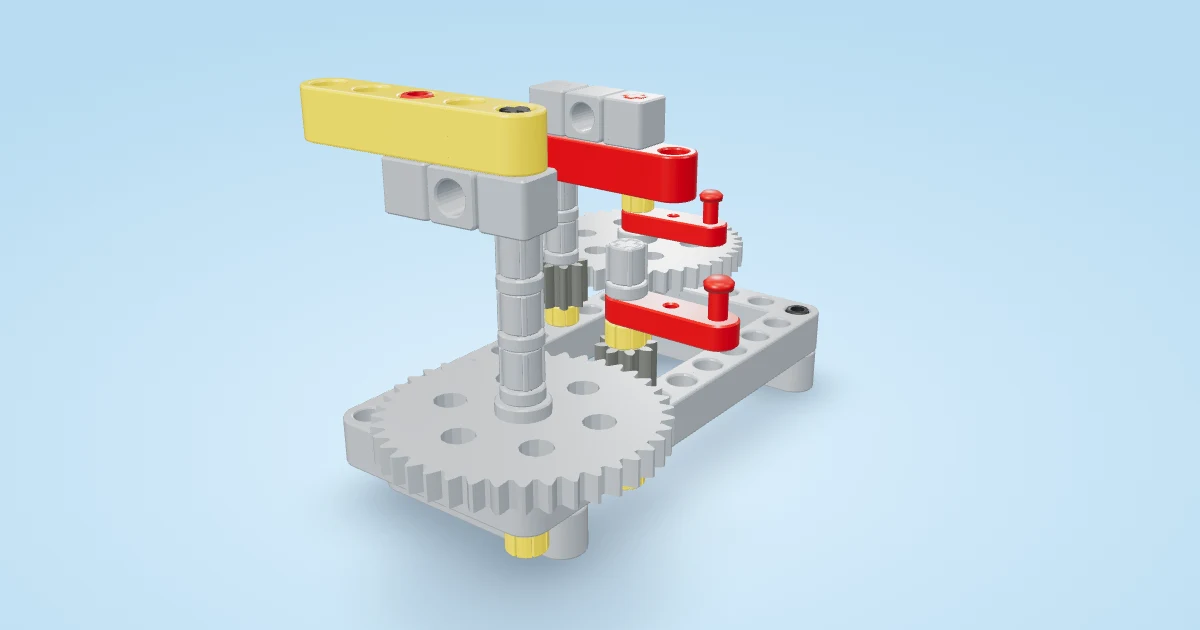
The Gear Speed Lab is the clearest hands-on version. It is a level 2 build of about 20 minutes with two cranks side by side. On one side a giant 40-tooth gear drives a tiny 8-tooth gear: one turn of the crank spins the propeller five times. On the other side the tiny gear drives the giant one, so you turn the crank five times to move the pointer once round.
Turn both cranks at the same speed. Then hold your finger lightly against the propeller and against the pointer. The fast side stops easily. The slow side pushes on through your finger. Same hands, same parts, opposite trade.
Speed on purpose: the Crank Cruiser
The Crank Cruiser uses the trade the other way round. It is a level 2 car of about 18 minutes where a 24-tooth gear drives an 8-tooth gear, so every turn of the handle spins the wheels three times. It rolls quickly, but you will feel the handle get heavier than a 1:1 drive would be. The build's own instructions point out that a crank is a lever that goes round and round: a longer handle means less force for your hand. You can check that in the winch above by sliding the handle length.
Strength on purpose: the Pull-back Tortoise
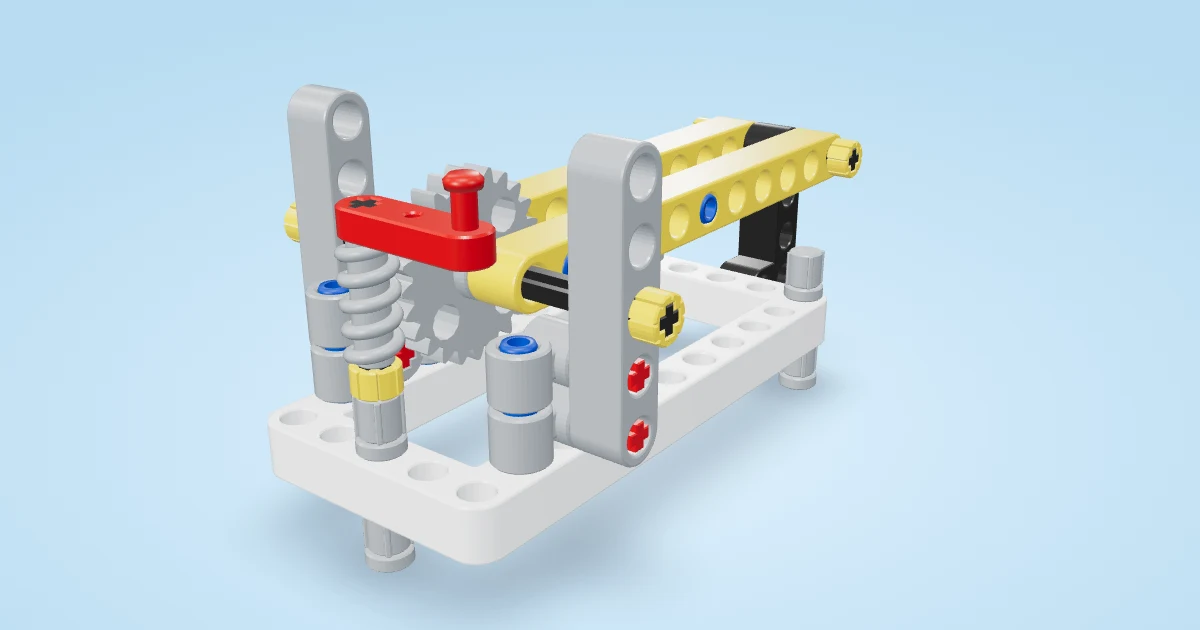
The Pull-back Tortoise flips the Crank Cruiser's gears: the 8-tooth gear on the motor axle drives a 24-tooth gear, three times slower and three times stronger. It is a level 2 build of about 30 minutes. Its challenge is to climb a ramp made from a book. Because the spring winds three times slower, you also have to pull it back three times further to wind it up. There is the trade again, hiding in the pull-back distance.
Compare it with a faster pull-back car on the same ramp, and write down which one climbs and which one is quicker on the flat. The pull-back car experiment shows how to make that a fair test.
The extreme: worm gears
A worm gear moves its gear by just one tooth per turn. In the Worm-Gear Crane, a level 3 build of about 30 minutes, the worm needs 24 whole turns to turn the 24-tooth gear once. That is the 24:1 option in the winch lab. The crane lifts its boom slowly but strongly, and the boom stays up when you let go: a worm is hard to drive backwards, mostly because of friction between its thread and the gear teeth.
The XL Power Crane (level 4, about 35 minutes) puts the same 24:1 worm behind an XL motor. The motor spins fast and weak; the worm turns that into slow and strong. More on why worms hold their load on the worm gear page.
A test to run at the table
- Build the Gear Speed Lab and put a small removable mark on the propeller and on the pointer.
- Turn each crank until its output has gone exactly once round. Count the crank turns.
- Turn each crank again while a fingertip rests lightly on the output. Rate how hard it is to keep going: easy, medium or hard.
- Predict how many crank turns the Worm-Gear Crane needs to turn its big gear once. Build it, mark one tooth, and check.
Write your results as a table with three columns: output, crank turns and how hard it felt. If one side scores both "few turns" and "hard to stop", look again: something may be slipping, or the counts may be off.
More gear builds to try next are in the gear builds collection.
Quick check
Interactive: Check yourself. A few quick questions on the ideas in this guide, each with an explanation.
- A winch needs 2 N of push with a 3-stud handle. You swap in a 6-stud handle and change nothing else. What push do you need now?
- You change a winch from 1:1 to a 5:1 reduction. What happens to the handle turns needed to lift the same bucket?
- Which change makes the push lighter AND the lift take fewer turns?
- In an ideal winch, the push is 20 times lighter than the load. How far does your hand travel compared with how far the load rises?