The engineering design process is a loop that engineers use to solve a problem: ask what the problem is, imagine ideas, plan one, create it, test it, and improve it, then go round again. Museum of Science’s Engineering is Elementary names the steps Ask, Imagine, Plan, Create and Improve. NASA’s BEST series adds an Experiment step before Improve. The names vary; the loop doesn’t.
The process is easiest to teach with one brief and real results. Here it is worked through with four free Technic-style builds that all use the same pull-back spring motor, plus a lab that checks the maths at each stage.
Ask: what is the problem?
The brief: make a pull-back car roll further for the same pull. The limit: every design uses the same spring motor, so the only things you can change are wheels and gears.
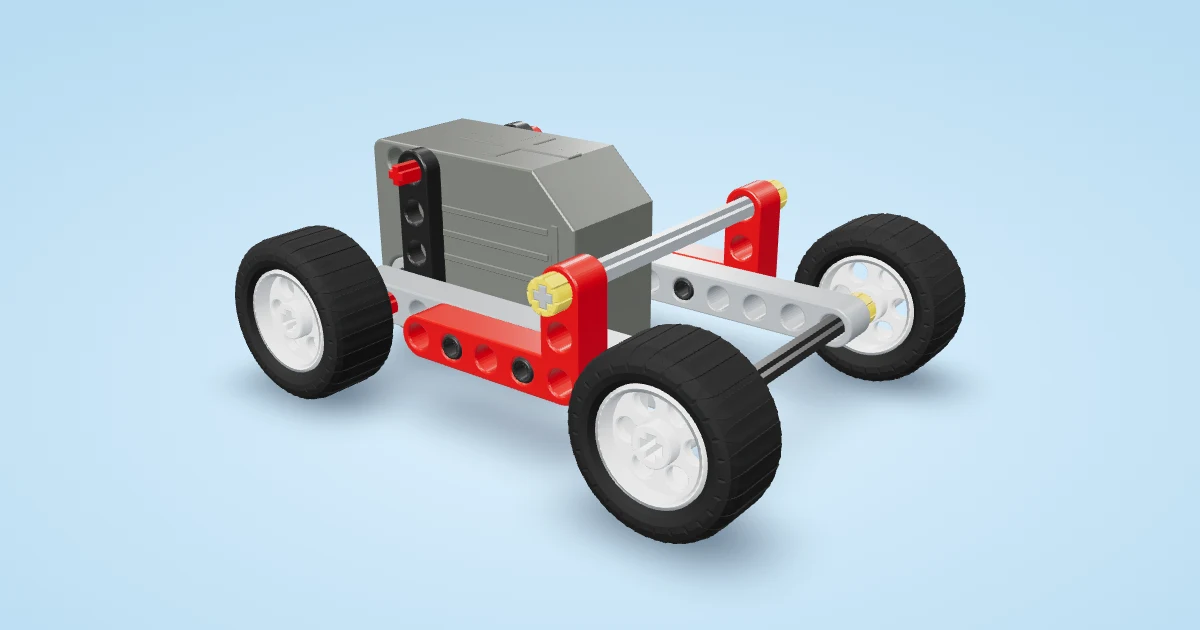
Start by measuring the starting point. The Pull-back Racer (level 2, about 12 minutes) has small 30.4 mm wheels straight on the motor axle. One spring turn is one wheel turn, so it rolls π × 30.4 ≈ 95 mm per spring turn. That is the number to beat. If your group hasn’t used pull-back motors before, start with the pull-back car experiment: it teaches the measuring and the fair-test habits this unit relies on.
Imagine: what could we change?
Two ideas come up in most groups:
- Bigger wheels. A wheel rolls π × its diameter each turn, so a bigger wheel goes further per turn.
- Gears. A big gear driving a small one turns the wheels more than once per spring turn.
Ask the group to predict what each idea costs as well as what it gains. Same spring, more distance per turn: what happens to the push?
Plan and create: build two ideas
The Big-Wheel Dragster (level 2, about 22 minutes) tests idea 1: 56 mm wheels on the same motor. Its build says the same spring pushes it almost twice as far as the Racer, and the maths agrees: 176 mm per spring turn, 1.84 times the Racer.
The Gear-Up Speeder (level 2, about 25 minutes) tests idea 2. The motor rides high and turns a 40-tooth gear, which drives a 24-tooth gear on the back axle with 43.2 mm wheels. The wheels turn 40 ÷ 24 = 1⅔ times per spring turn, so it rolls about 226 mm per spring turn: the furthest of all on paper. Its own build page warns: “Faster wheels — but less push. Will it win the race, or run out of power? Test it!”
Work through the same steps in the lab. Each challenge is one stage of the process:
Interactive: Pull-back design lab. One design brief, five designs from four real pull-back builds: compare how far each rolls per spring turn and how hard it can push, and see why the design that goes furthest on paper may lose on carpet. Five challenges, one per stage of the design process.
Test: what actually happens?
The lab shows the trade-off: with no losses, push at the floor goes down by exactly as much as distance per turn goes up. The Speeder can push only about 0.42 times as hard as the Racer. On a smooth floor that may be plenty; on carpet or a slope it may stall. Maths can’t settle that. A fair test can.
Use one floor, one pull length (the Dragster’s build suggests one hand-length), and three runs per car. Measure from the start line to where the car stops, and write the floor type above the table.
| Car | Run 1 (cm) | Run 2 (cm) | Run 3 (cm) |
|---|---|---|---|
| Pull-back Racer | |||
| Big-Wheel Dragster | |||
| Gear-Up Speeder |
The blanks are for your class’s results: we haven’t run these tests. Repeat the table on a second floor, such as carpet, and see whether the order changes.
Improve: change one thing and test again
Improving rarely means starting again. It means using what the test showed. If the Speeder stalls on carpet, the next design needs more push, not more distance.
That is exactly what the Two-Speed Pull-back (level 3, about 35 minutes) offers. Its CLIMB gear has an 8-tooth gear driving a 24, so it rolls only about 45 mm per spring turn but can push about 2.1 times as hard as the Racer. Push one back wheel in by a hole and its SPRINT gear (16 → 16) rolls about 136 mm per turn for the flat. Its build asks: which gear climbs a ramp, and which goes furthest on the flat? That is a new brief, and the loop starts again.
Running it with a group
- Keep the limit fixed. Same motor, same pull, same floor. Students change only wheels or gears.
- Make predictions visible. Before each build, write the predicted distance per turn and whether the push goes up or down.
- Let a design fail. A stalled Speeder on carpet is the most useful result in the unit, because it shows why testing matters.
- Share. Each group presents its best design, its test results and what it would change next.
For more on why gears trade speed for force, see what is torque and the gear ratio worksheet. For planning a whole term, see running a building club.
The four builds span the starter and gearbox packs, so the Complete MightyCog booklet collection covers them all, and every booklet is free on its build page.
Interactive: Check yourself. A few quick questions on the ideas in this guide, each with an explanation.
- What is the first step of the engineering design process?
- The Big-Wheel Dragster has 56 mm wheels; the Pull-back Racer has 30.4 mm wheels. Both sit on the same spring motor. Which rolls further per spring turn?
- The Gear-Up Speeder rolls the furthest per spring turn. Why might it still lose on carpet?
- What does the “improve” step usually look like?