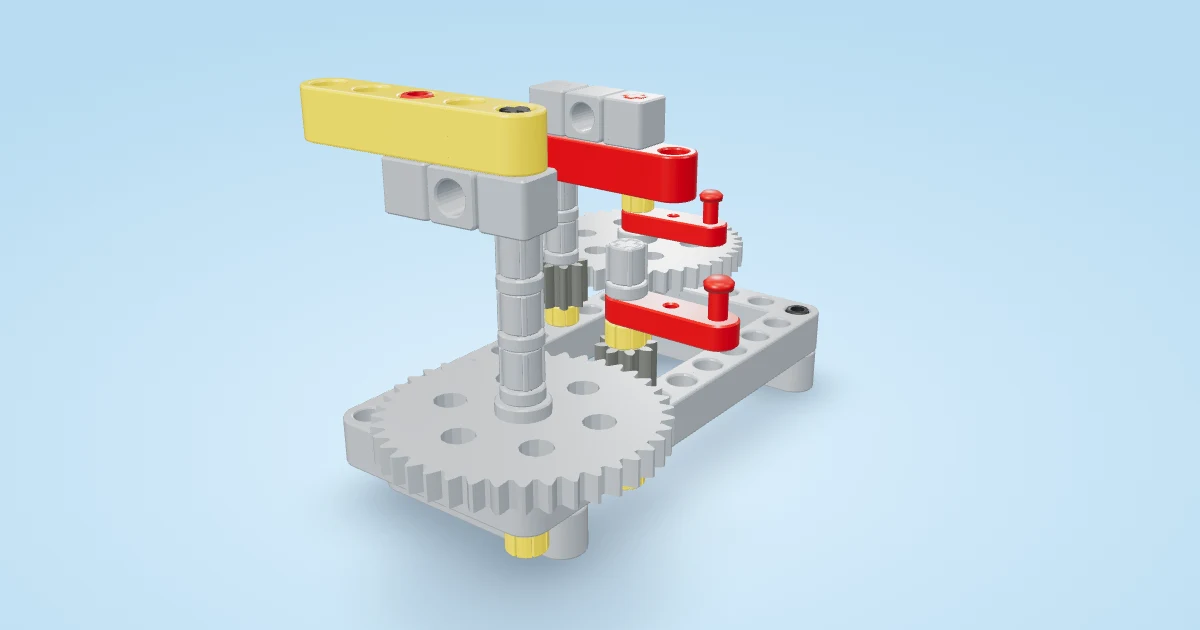
Calculate a gear reduction ratio by dividing the driven gear's teeth by the driver gear's teeth. Divide the number of input turns by that ratio to predict the output turns. This worksheet lets you practise the calculation, check answers, and compare your predictions with a hand-cranked model. No motor, account or paid download is required to follow the exercise.
Choose a build and identify the input
Begin with Gear Friends if meshing gears are new to you. Follow its parts checklist and animated steps, then turn one axle slowly and watch the neighbouring gear. The gear you turn is the driver. The gear it turns is the driven gear. Mark the two axles with removable tape so you can count whole turns without losing your place.
For a direct comparison, use the Gear Speed Lab. This level 2 build takes about 20 minutes according to its guide and follows Gear Friends. One pair has a 40-tooth driver and an 8-tooth driven gear. The other has an 8-tooth driver and a 40-tooth driven gear. Check that you have the required parts before choosing it; compatible parts still need to fit the intended assembly.
Use one ratio convention throughout
Here, reduction ratio = driven teeth divided by driver teeth. A ratio of 5 means five input turns per output turn. A ratio of 0.2 means one fifth of an input turn per output turn, so the output turns five times for one input turn. Writing the meaning beside the number prevents confusion when another resource uses the opposite convention.
With an 8-tooth driver and a 40-tooth driven gear, calculate 40 divided by 8 = 5. Five input turns give one output turn. With a 40-tooth driver and an 8-tooth driven gear, calculate 8 divided by 40 = 0.2. One input turn gives five output turns. Read the gear ratio explanation if you want to see why the tooth counts control the motion.
Try it before you build: set up any pair in the simulator below, predict the driven gear's turns, then turn the crank and count. The worksheet checker underneath sets a new question each time and shows the working.
Interactive: Gear pair simulator. Pick a driver and a driven gear, turn the input and watch both gears mesh. The ratio, output turns and direction update as you go, and a worksheet checker sets fresh questions.
Copy this worksheet into your test log
Use paper or your own notebook. For each question, record the driver teeth, driven teeth, reduction ratio, input turns and predicted output turns. Leave a separate space for what you actually observe. Predictions and measurements belong in different columns, even when they agree.
- An 8-tooth driver turns a 24-tooth driven gear. What is the reduction ratio? Predict the output turns for six input turns.
- A 24-tooth driver turns an 8-tooth driven gear. Predict the output turns for two input turns.
- A 16-tooth driver turns another 16-tooth gear. Predict the output turns for four input turns and describe the direction.
- On the fast side of the Gear Speed Lab, a 40-tooth driver turns an 8-tooth driven gear. Predict the output turns for two input turns.
- On the slow side, an 8-tooth driver turns a 40-tooth driven gear. How many input turns produce two output turns?
- Two reduction stages are connected in series. The first has an 8-tooth driver and a 24-tooth driven gear; the second has an 8-tooth driver and a 40-tooth driven gear on the next stage. Find the combined reduction ratio.
For the last question, the first stage's output axle drives the second stage's input. This is a compound train, not a row of three gears with an idler between them. You can compare stages in the gear ratio calculator and motor simulator without adding them to the test bench.
Test the two pairs fairly
Count turns on the physical Gear Speed Lab rather than timing how quickly you can crank. Turn slowly, start both marks in a known position, and count the input and output rotations. Repeat each measurement three times. Keep the frame and gear spacing unchanged. If gears slip, bind or skip teeth, record that and repair the assembly before repeating the test.
- Pair tested: __________. Driver teeth: _____. Driven teeth: _____.
- Prediction: _____ output turns for _____ input turns.
- Trial 1: _____ input turns; _____ observed output turns.
- Trial 2: _____ input turns; _____ observed output turns.
- Trial 3: _____ input turns; _____ observed output turns.
- Agreement or difference: __________. What I checked next: __________.
Check your answers
- The reduction ratio is 3. Six input turns produce two output turns.
- The reduction ratio is one third. Two input turns produce six output turns.
- The ratio is 1. Four input turns produce four output turns. Two externally meshing gears turn in opposite directions.
- The ratio is 0.2. Two input turns produce ten output turns.
- The ratio is 5. Ten input turns produce two output turns.
- Multiply 3 by 5 to get a combined reduction ratio of 15. Fifteen input turns produce one output turn.
These are ideal turn relationships for correctly connected gears. They are not measured motor speeds or promises about how far a car will travel. A larger reduction increases ideal output torque while reducing speed; friction and the load affect actual performance. Use the torque guide to connect the calculation to turning force.
Extend the experiment to a vehicle
After counting turns, try the Crank Cruiser and identify its input and driven wheels. Wheel diameter also affects distance travelled, so changing wheels and gears together makes the cause harder to identify. Choose one change, predict its effect, and compare repeated tests. The gear builds collection offers further projects when you are ready for a different mechanism.
Interactive: Check yourself. A few quick questions on the ideas in this guide, each with an explanation.
- An 8-tooth driver turns a 40-tooth driven gear. What is the reduction ratio?
- Two gears mesh directly. The driver turns clockwise. Which way does the driven gear turn?
- A 24-tooth driver turns an 8-tooth driven gear. How many output turns for 2 input turns?
- Stage one is 8 → 24 and stage two is 8 → 40 on the next axle. What is the combined reduction?