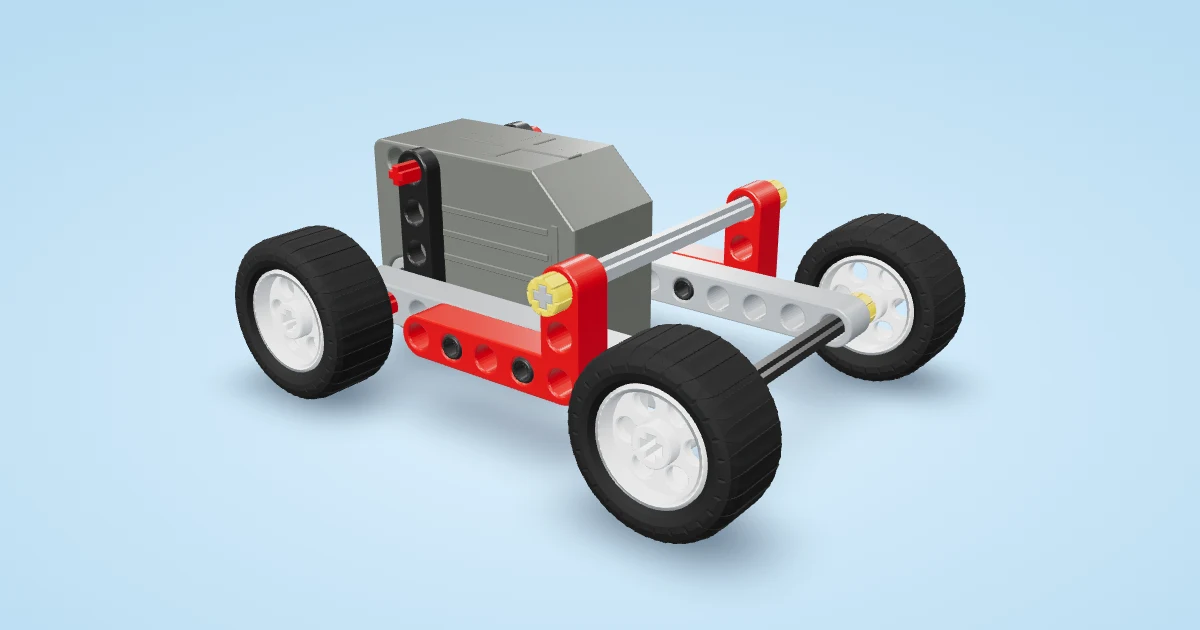
A pull-back car is the best science kit you can build in half an hour. You pull it back, a spring inside winds up, and when you let go the spring unwinds and drives the wheels. That spring is stored energy, and because the car stops in a different place each time, it's perfect for measuring. All you need besides the build is a hallway, a roll of masking tape and a tape measure.
This is a real fair test, the same kind scientists run: change one thing, keep everything else the same, measure, and repeat.
What you need
- One pull-back car. The Pull-back Racer takes about 12 minutes and introduces the basic mechanism.
- Masking tape for a start line, and a tape measure or a long ruler.
- A pencil and a piece of paper for a results table.
- A smooth floor with a few metres of space (a hallway is ideal).
Experiment 1: does pulling back further make it go further?
- Mark a start line with tape. Put a second small piece of tape 10 cm behind it.
- Put the front wheels on the start line, roll the car back to the 10 cm mark, and let go. Don't push it.
- Measure from the start line to the front of the car where it stops. Write it down.
- Do it three times and take the middle result. Then repeat with 20 cm and 30 cm.
Most cars go further with a longer pull, up to a point. On most pull-back motors, pull too far and a clutch inside starts clicking: it's full, and extra pulling stores nothing more. Ask a building partner to find that point. The stored energy page explains what is going on.
Experiment 2: does weight slow it down?
Keep the pull-back distance the same (say 20 cm). Now add weight: a few spare beams, then a few more. Measure each time.
Adding mass may change acceleration, tyre grip and rolling losses, so predict the outcome and measure it rather than assuming the heavier car always travels less far. Secure the spare beams in the same place without rubbing against a wheel or axle. Record the number and type of pieces added; use a scale if you want to report mass. The friction guide explains why the surface matters. Test carpet and a smooth floor separately, keeping the load constant for that comparison.
Experiment 3: speed or distance? (gears)
Once the basics are clear, compare gearing. The same spring can drive the wheels through different gears.
- The Gear-Up Speeder uses a big gear to spin the wheels faster.
- The Pull-back Tortoise gears it the other way: slow, but strong enough to climb.
- The Big-Wheel Dragster uses big wheels, so each turn of the axle covers more ground.
Compare them on the same track with the same measured pull-back distance. Which one reaches one metre first? Which travels furthest? Which climbs a ramp? These are exploratory comparisons: different cars also change wheel size, mass and construction, so they do not isolate the effect of gears. Record those differences alongside the results. The gear ratio and torque pages explain the ideal speed and turning-force tradeoff; real travel also depends on losses and grip.
For the full version, the Two-Speed Pull-back has a CLIMB gear and a SPRINT gear on one car. Slide the back axle to swap gears and run the same test twice. Changing only the gear is a textbook fair test.
A results table to fill in
Copy or print this table. Measure the distance from the same start reference to the same point on the car for every run. Put the three distances in order and use the middle one as the median. For example, 110, 95 and 103 cm give a median of 103 cm. Keep units beside every measurement.
| Pull-back distance (cm) | Run 1 travel (cm) | Run 2 travel (cm) | Run 3 travel (cm) | Median travel (cm) |
|---|---|---|---|---|
| 10 | ______ | ______ | ______ | ______ |
| 20 | ______ | ______ | ______ | ______ |
| 30 | ______ | ______ | ______ | ______ |
Record the car, surface, wheel size and any added pieces above the table. Stop increasing the pull when the motor reaches its winding limit; do not force it. For a graph, put pull-back distance on the horizontal axis and median travel on the vertical axis. A flattening curve could indicate a winding limit, but wheel slip, a wall or floor changes can also limit travel. Check the observation before choosing an explanation.
For a gear-only test on the Two-Speed Pull-back, keep the same car, wheels, load and surface. Use one pull-back distance and make a separate three-trial record for each gear. Practise predicting axle turns with the gear ratio worksheet and answers, or compare ideal speed and torque in the gear ratio calculator.
Log your runs here
Prefer a screen to paper? Use the results log below. Pick the experiment, write your prediction and your reason, then type each run as you measure it. It works out the median, the mean and the spread, flags a run worth repeating and draws the graph. Your log stays in this browser.
Interactive: Fair-test results log. Predict, then record three runs for each setting of a pull-back car experiment. The log works out the median, mean and range, flags a run worth repeating, draws the chart and drafts a careful conclusion.
Questions to ask afterwards
- "What did we change? What did we keep the same?"
- "Which result surprised you?"
- "If you designed a pull-back car to win a race up a ramp, what would you change?"
- "Where else is energy stored in a spring?" (wind-up toys, clockwork, a trampoline, a bow)
Interactive: Check yourself. A few quick questions on the ideas in this guide, each with an explanation.
- In Experiment 1, what is the one thing you change?
- Three runs travel 110, 95 and 103 cm. What is the median?
- Why do we do three runs instead of one?
- Comparing the Speeder, the Tortoise and the Dragster, why is this not a fair test of gears alone?
Taking it to the classroom
For a group, give each pair a different car and one shared track, then compare results on the board. The Blueprint Lab Explorers track (Foundation) and Inventors track (Intermediate) include lessons built around fair tests like this, with a Test Log to fill in. All the pull-back cars live together in the pull-back car builds collection.