Give each month one idea, a short warm-up build, a main build, one test and one look-back. Here is a ten-month plan built that way from our free instructions. Each build comes after the builds its instructions suggest doing first, and the levels climb from 1 to 4:
| Month | Idea | Main build |
|---|---|---|
| 1 | Rolling, frames | Push Buggy |
| 2 | Gear ratio | Gear Speed Lab |
| 3 | Levers | Parking Barrier Gate |
| 4 | Stored energy | Spring Catapult |
| 5 | Worm gears | Castle Drawbridge |
| 6 | Bevel gears | Egg Beater |
| 7 | Linkages, cams | Cam Drummer |
| 8 | Motors | Spinning Radar |
| 9 | Gearboxes | Clutch-Gear 2-Speed Car |
| 10 | Walking machine | Klann Walking Spider |
Ten four-week months make a 40-week year. The planner below lists every warm-up, test and session count.
Why ten months and not 36 weeks?
Many homeschool plans use 36 weeks, because 180 days at five days a week is 36 weeks. Layers of Learning’s guide to planning a year gives that sum and then says its author plans 40 weeks of work and keeps the other 12 for breaks, some in summer and some through the year. It also suggests an undated pacing guide, because “life happens”.
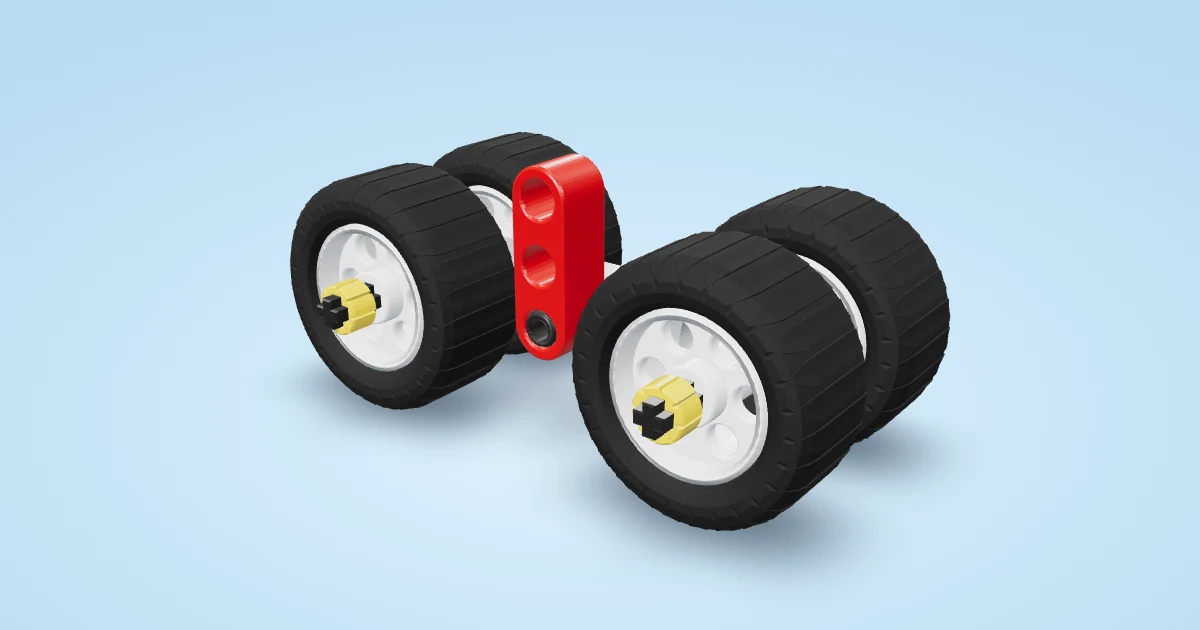
This plan works the same way: months are numbered, not named. For a 36-week year, fold month 1 into the start of month 2. Its two builds, the Tiny Roller and the Push Buggy, take about 20 minutes together.
How each month runs
- Warm-up. A quicker build that shows the idea in its simplest form, such as Gear Friends before the Gear Speed Lab.
- Main build. The bigger model. The minutes come from its instructions, so a first-time builder may need longer.
- Test. One thing to measure or compare, taken from the build’s own “try this” notes. In month 5 you count crank turns to raise the Castle Drawbridge, then let go halfway to see the worm gear hold it.
- Look-back. From month 2 on, rebuild or re-test a model from an earlier month. A guide on interleaved practice from Lindenwood University sums up the research: reviewing old and new ideas together beats finishing one topic and moving on, even though it feels harder. Month 6’s look-back might put the Gear Speed Lab beside the Egg Beater: both change speed, but only one turns the motion round a corner.
Everything else is free building: changing a model, or inventing one. The engineering design process post is a good structure for those sessions.
Why the order matters
Each build lists the builds it is meant to follow. The Klann Walking Spider lists the Motor Buggy and the XL Power Crane. The XL Power Crane lists the Worm-Gear Crane, and that lists the Gear Speed Lab. So the walker sits at the end of a chain that starts in month 2. The planner’s test file checks every link in that chain, so the order stays true if a build changes.
The levels rise slowly. Months 1 to 4 use level 1 and 2 builds. Motors arrive in month 8, by which time gears, levers and worm gears are familiar. For the full order of every build on the site, not just these twenty, see the learning path.
Plan your sessions
Set how many sessions you run a week and how long each one is. The planner counts the build sessions each month needs (rounding up), adds the test and the look-back, and shows what is left:
Interactive: Homeschool year planner. Pick how many sessions a week and how long each is. Ten months of builds, each with a test and a look-back session, fit into four-week months, and the planner shows which months run over and how many sessions are left for free building. Five predict-then-check challenges.
Two results surprise most people. First, all twenty builds add up to only about 8 hours of following instructions. Second, even one 30-minute session a week fits eight of the ten months. Only months 9 and 10 run over, and you can fix that by giving each a fifth week.
What you need
One parts kit covers the whole year if you sort it once. Our sorting and storage guide shows how, and the parts list shows what is in it. Months 8 to 10 need a motor and battery box: the first motor build post covers wiring and what to do when nothing moves.
If you teach more than one builder, the building club guide has the Builder, Finder and Tester roles. The guide also covers pairs, so the roles suit two siblings as well as a class.
Keep a record
A notebook page per month is enough:
| Month | What we tested | What we found |
|---|---|---|
| 1 | ||
| 2 |
By month 10 that page is a portfolio. It shows what was built, and also what was measured and changed.
Interactive: Check yourself. A few quick questions on the ideas in this guide, each with an explanation.
- How long do all twenty builds in the plan take to build, added up?
- Why does each month after the first have a look-back session?
- A month needs 95 minutes of building in 45-minute sessions. How many build sessions?
- Why does the Klann Walking Spider come last?