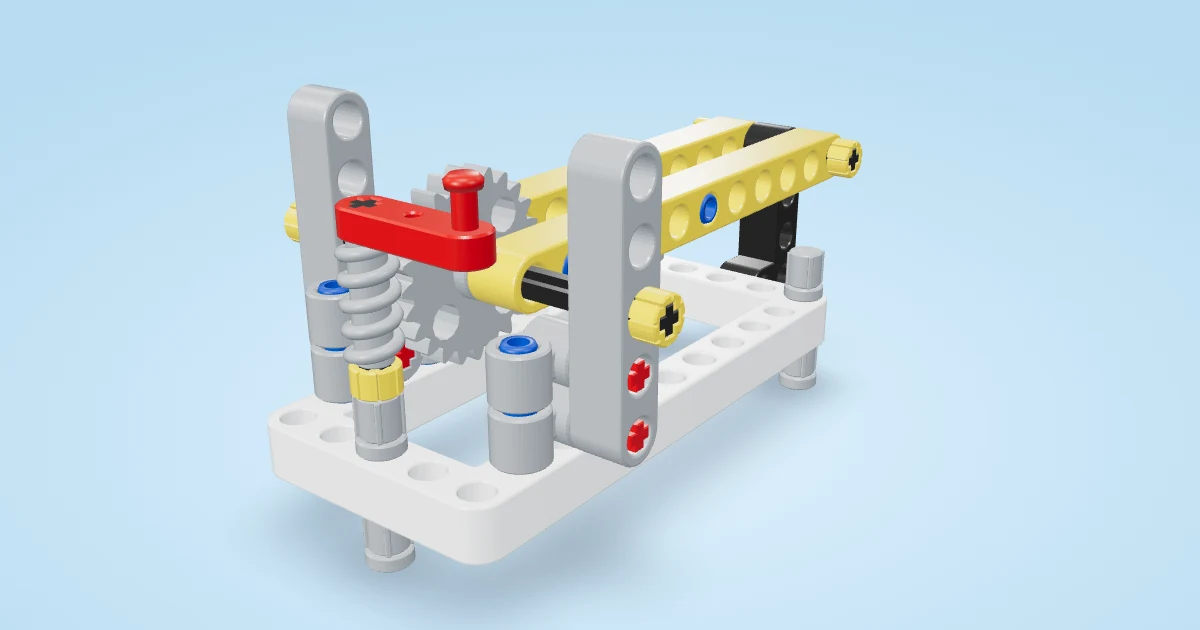
Look at which gear is doing the driving. If a bigger gear drives a smaller one, you are gearing up: the output spins faster, with less turning force. If a smaller gear drives a bigger one, you are gearing down: the output turns slower, with more force. Equal gears keep the same speed. To see how much, divide the driving gear’s teeth by the driven gear’s teeth.
The quickest way to make that stick is to sort some real machines. Below are seven gear pairs from seven builds. Predict each one, then look for the pattern.
The one-look rule
Every pair of gears has a driver, the gear your hand, the wheels or a motor turns, and a driven gear that it turns. Wikipedia’s gear article puts the trade in one line: when a small gear drives a larger one, the turning force goes up and the speed goes down, and “the opposite effect is obtained when a large gear drives a small one”.
So you only need two numbers:
- Output turns per input turn = driver teeth ÷ driven teeth.
- More than 1: gear up. Less than 1: gear down. Exactly 1: same speed.
A worm counts as a gear with one tooth (a “single thread”), which is why a worm turning a 24-tooth gear needs 24 turns for one: the biggest reduction of the seven.
The trade is fair, not free. Gearing up doesn’t create speed from nowhere: you pay for it in force, and the reverse, minus a little lost to friction. What is torque? lets you feel that trade with your own hands.
Sort seven real gear pairs
Interactive: Gear up or gear down? sorter. Seven real gear pairs from seven builds, from the Propeller Push Car to the Worm-Gear Crane. Predict whether each gears up, gears down or keeps the speed, see the output turns per input turn, then spot what decides it.
The seven, explained
Propeller Push Car: gear up, 3 times. The Propeller Push Car is a level 1 build of about 12 minutes, with no batteries at all. Its back axle carries a 24-tooth gear that drives an 8-tooth gear on the propeller axle: 24 ÷ 8 = 3. Push slowly and count: one wheel turn, three propeller turns. Propellers that whizz are the whole point, so it gears up.
Odometer Cart: gear down, 5 times. On the Odometer Cart an 8-tooth gear on the front axle turns a 40-tooth counter: the flag goes round once every five wheel turns. Here slow is the goal, because each flag turn stands for a bigger distance you can count.
Flywheel Friction Car: gear up, 5 times. The Flywheel Friction Car turns that pair the other way round: a 40-tooth gear on the back axle spins an 8-tooth gear and the heavy flywheel five times per wheel turn. How a friction car works explains why spinning it fast matters.
Motor Buggy: gear down, 3 times. On the Motor Buggy, the M motor’s 8-tooth gear turns a 24-tooth gear on the back axle. Its instructions put it plainly: the wheels go 3 times slower but 3 times stronger.
Idler Parade Car: same speed. The Idler Parade Car (level 1, about 20 minutes) has a 24-tooth gear on its back axle and a row of four more 24-tooth gears on top. Equal teeth all the way, so every gear turns at wheel speed, each one the opposite way to its neighbour. As Wikipedia’s gear train article says, an in-between gear “provides spacing but does not affect the gear ratio”. Why an idler gear doesn’t change the final ratio goes further.
Worm-Gear Crane: gear down, 24 times. On the Worm-Gear Crane, a hand crank turns a worm that turns a 24-tooth gear on the boom. Slow and strong lifts the boom, and the worm also holds it up when you let go. How worm gears work explains that.
Twin-Motor Dozer: gear down, 5 times. The Twin-Motor Dozer drives each track from its own motor, an M on one side and an L on the other, through an 8-tooth gear on a 40-tooth gear. A level 5 build, it is the hardest of the seven.
What decides it
Cars sit on both sides, so it isn’t about the kind of model. It is about what the output has to do:
- Needs speed (propellers, a flywheel): gear up.
- Needs force or slowness (wheels pushed by a motor, a crane lifting, a counter): gear down.
- Only needs to pass the turning along (idlers): same speed.
Motors are the clearest case. A small electric motor spins fast but not strongly, so both motor builds here gear it down before it reaches the wheels or tracks.
Try it on your bench
Take two gears of different sizes and two axles. Mark one tooth on each with a piece of tape, turn the driver once, and count the driven gear’s turns. Then swap which one you turn. The gear ratio worksheet has a blank table for exactly this.
Check yourself
Interactive: Check yourself. A few quick questions on the ideas in this guide, each with an explanation.
- A 40-tooth gear drives an 8-tooth gear. This is…
- Gearing down makes the output…
- A row of equal 24-tooth gears, one after another, makes the last gear…
- Why do most motor builds gear down?