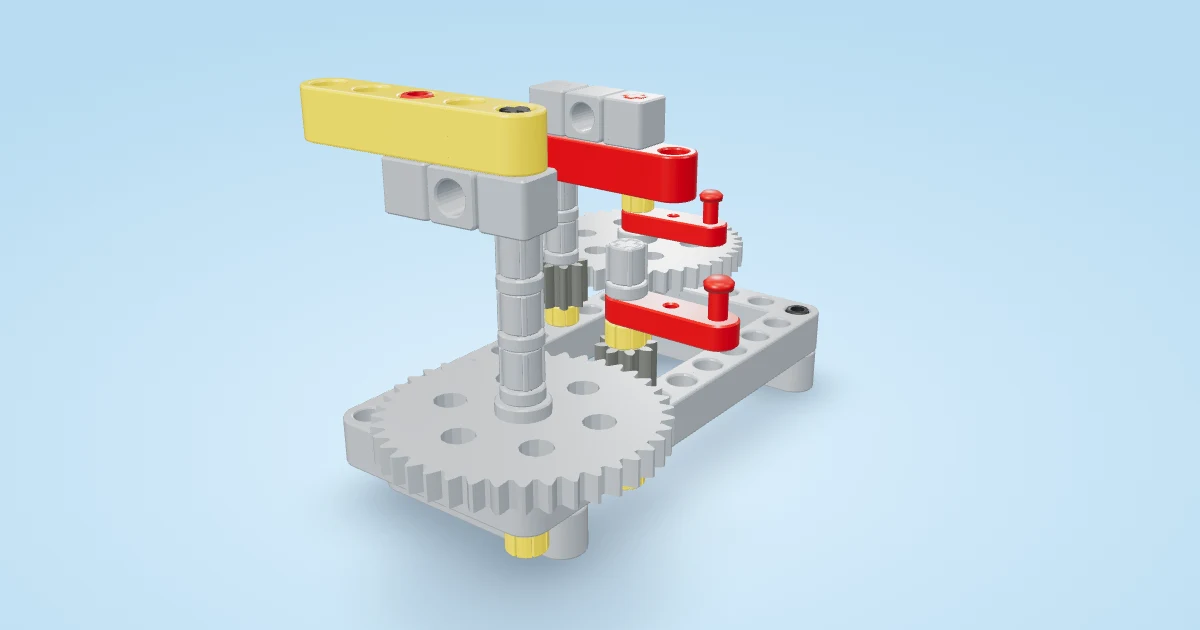
A middle gear can spin much faster than the input while leaving the output speed unchanged. In a simple train of three external gears, the middle gear’s tooth count appears once as a divisor and once as a multiplier, so it cancels from the final ratio. Equal end gears therefore turn equally. That describes ideal motion, not how much friction or effort the real mechanism needs.
Make a prediction before turning
Our new Speed-Cancelling Gear Bridge uses a 40-tooth input, an 8-tooth middle gear and another 40-tooth output. Before touching the input, predict three things: how many turns the middle will make, how many turns the output will make, and which direction each will turn. Write your answers rather than changing them after the test.
Use the interactive experiment below to turn the input through 360 degrees. The readout counts one input turn, five reverse middle turns and one forward output turn. Try a second input turn. Then choose a different middle tooth count while keeping both end gears at 40. The middle speed changes; the final ratio does not. The diagram is a mathematical schematic, so changing a menu does not mean those gears fit the same physical holes.
Interactive: Speed-cancelling gear bridge. Predict the output direction of a 40–8–40 gear train, then turn the input. One input turn makes five reverse middle turns and one forward output turn: two external meshes reverse the direction twice, and changing only the middle gear leaves the final ratio unchanged.
Build the three shafts
Open the new build’s parts list before assembling anything. Its five steps put three retained vertical shafts into a flat frame. Full bushes sit below the frame, gears sit above it, and top bushes keep the parts together. Each pair has its own correct centre spacing. The tiny gear must meet both larger gears at the same height, with teeth entering gaps rather than pushing against teeth.
Our bench is an original small educational model inspired by the engineering question in the credited long gear-train demonstration. It is not a miniature copy or a set of instructions for that creator’s exact machine. Use MightyCog’s animated steps and free booklet for this bench. They show the intended assembly; you still need to check that your actual parts turn freely. Do not squeeze a rotating gear hard against the frame with its top bush.
Follow the teeth through both meshes
The first 40-tooth gear brings forty teeth past the contact in one complete turn. The 8-tooth gear has only eight teeth, so it must make five turns to pass the same number through the mesh. It turns in the opposite direction because the gears touch externally. Learn the basic relationship on the gear ratio page.
Those five middle turns bring forty teeth past the second contact. The final 40-tooth gear needs one turn to accept them. This second mesh reverses direction again, so the output follows the input. Multiplying the stage factors gives 40 divided by 8, multiplied by 8 divided by 40: five multiplied by one fifth equals one. The two minus signs also multiply to a positive direction.
The cancellation applies to a simple train with one gear on each shaft. A compound train places different gears on a shared intermediate shaft, and their tooth counts do not generally cancel. A belt, internal gear or slipping clutch also changes the assumptions. The idler explanation and simpler Gear Friends build provide useful comparisons, but this bench focuses on a fast unequal middle gear between equal ends.
Run a fair counting experiment
Put a removable mark on each shaft’s top bush. Pick a fixed starting direction and turn the red input slowly through one complete turn. Count the middle turns and watch the blue output. Repeat three times, then turn the input backwards. Reverse motion should reverse all three signed counts without changing their magnitudes. Keep fingers clear of the tooth contacts and stop if anything binds.
Record input turns, middle turns, output turns, direction and any sticking in a small table. A tiny start-up delay after reversing can come from clearance between teeth. That is different from a changed steady ratio. Count complete turns after the gears engage rather than treating every initial hesitation as a broken ratio. Do not claim a measured speed or efficiency from the animation: it is an idealized 3D model, not a physical test.
Change one idea at a time
In the interactive lab, keep the end gears at 40 and compare middle gears with 8, 16 and 24 teeth. Predict which middle shaft will be fastest. Then keep the middle at 8 and change the output from 40 to 24. The output now makes forty twenty-fourths of a turn per input turn. Equal ends caused the earlier equality; the presence of three gears alone did not.
For a physical alternative, use the separate Gear Speed Lab and follow its own instructions. Different tooth counts require suitable centre spacing and retention. Do not move an axle by eye until gears appear to touch. A loose support, wrong height or shaft that slides can make a correct mathematical prediction fail in practice.
Interactive: Check yourself. A few quick questions on the ideas in this guide, each with an explanation.
- The 40-tooth input makes one turn. How many turns does the 8-tooth middle gear make?
- Which way does the 40-tooth output turn compared with the input?
- You swap the 8-tooth middle gear for a 24-tooth one and keep both ends at 40. What happens to the output?
- Keep the 8-tooth middle and change the output to 24 teeth. How far does the output turn per input turn?
Equal speed does not mean free motion
The credited demonstration adds many gears while retaining a 1:1 end ratio. Its scale makes another question visible: what does every added contact cost? Our short bench teaches the ratio with only two meshes, making it easier to inspect and count. The source video is an independent demonstration, not our build tutorial or evidence of our bench’s performance.
Each real mesh and bearing can introduce friction, flex and clearance. A 1:1 speed ratio does not promise identical input and output torque, zero energy loss or limitless train length. Compare the ideal counts with observations from your own model. The useful result is an explanation you can test: the middle gear changes its own speed, the end tooth counts set the overall speed, and real construction determines how smoothly that prediction can happen.