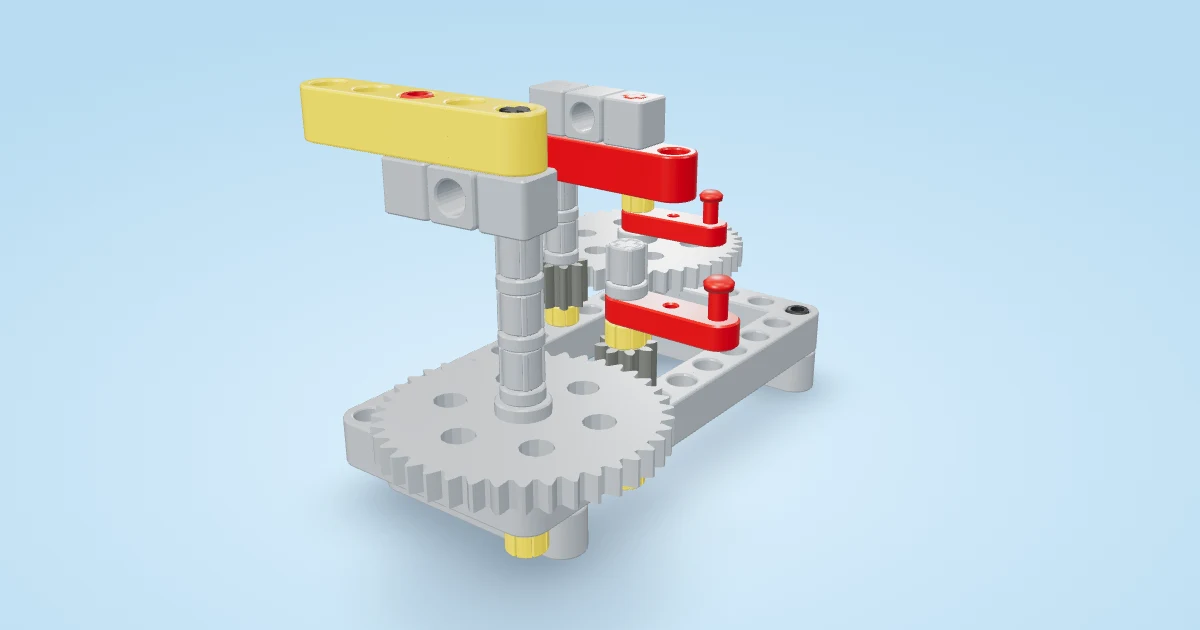
Gears are wheels with teeth that push each other round. That one sentence is enough to start with. Everything else about gears (direction, speed, strength) is something a builder can observe directly in a few minutes, as long as they have two gears in their hands. Explaining gears with words alone is hard; explaining them with a build that turns is easy.
Here is the order we use: direction first, then speed, then strength. Each step has a build that shows it.
Step 1: which way does it turn?
Put two gears side by side so their teeth touch. Turn one clockwise. Ask: which way does the other one go? Notice that it goes the other way.
Now add a third gear in a row. Which way does the last one go? It turns the same way as the first. The middle gear is called an idler gear: it doesn't change the speed, it only flips the direction back.
Build it: Gear Friends is three gears on a frame and takes about 8 minutes. The idler gears page has the plain-language explanation and a question to try: with an odd number of gears in a row, do the ends turn the same way?
Try it below before you reach for real gears: line up two to five gears, then play "predict the last gear". Say which way the last gear turns and whether it is faster or slower, then turn the crank and check. Swap a middle gear for a giant one and watch what the last gear does.
Interactive: Gear train playground. Line up two to five gears, change their sizes and predict which way the last one spins before you turn the crank.
Step 2: big gear, small gear
Now use a big gear and a small gear. Put a mark on each one with a sticker. Turn the big gear once, slowly, and count how many times the small gear goes round.
If the big gear has 24 teeth and the small one has 8, the small gear goes round 3 times. That number is the gear ratio. You can start with the observed motion before introducing the term "ratio": "the big one makes the small one spin fast" is the idea, and the counting proves it.
Build it: Gear Speed Lab is a test bench made for exactly this: two cranks, two gear pairs, one pair set up for speed and one for strength. It takes about 20 minutes, and the gear ratio page turns it into a small experiment.
Step 3: fast or strong, pick one
This is a useful part of the experiment, and it is the most useful. Turn it around: let the small gear drive the big one. The big one now turns slowly, but it is much harder to stop.
Ask a building partner to hold the output axle with their fingers while you turn the crank. Is it easier to stop the fast side or the slow side? They will feel that the slow side pushes harder. Engineers call that turning strength torque: slower gears are stronger gears. That is why a bike has low gears for hills, and why cranes and winches use tiny gears driving huge ones.
Build it: go back to the Gear Speed Lab and try its STRONG crank, then build Crank Cruiser, a car you drive with a handle where every turn of your hand spins the wheels three times. Ask: is it fast? Is it easy to drive up a ramp made from a book? The torque page explains the trade in plain language.
Step 4: gears that count
Once the basics click, gears become tools. A gear train can count wheel turns, which is how the mileage counter in a car works.
Build it: Odometer Cart is a push cart where five turns of the wheels make a flag go round just once. Roll it across the room and count the flag's turns, then ask: how far does the cart go for one turn of the flag? How would you make the flag turn even slower? (Answer: a bigger gear driving the flag.)
Questions that work well
- "If this gear turns this way, which way will that one turn?" (predict first, then test)
- "How many times will the little one go round?" (count, don't guess)
- "Which one would you use to lift something heavy?"
- "Where have you seen gears before?" (bikes, clocks, egg beaters, cars)
Common mix-ups
"The big gear is faster because it is bigger." The teeth on the big gear move at the same speed as the teeth on the small gear; it's the number of turns that differs. Counting with stickers clears this up.
"More gears make it faster." Adding gears of the same size in a row changes only the direction. Speed changes only when the sizes change.
"Gears have to touch in a straight line." They don't. Bevel gears turn the motion around a corner, and a worm gear turns it through a right angle and locks it in place. Those are great next steps once the basics are solid.
Ready to check what stuck? Four quick questions, one try each.
Interactive: Check yourself. A few quick questions on the ideas in this guide, each with an explanation.
- Three gears sit in a row. The first turns clockwise. Which way does the third turn?
- An 8-tooth gear drives a 24-tooth gear. How many turns of the 8 make the 24 go round once?
- A 16-tooth gear drives a 40-tooth idler, which drives a 16-tooth gear. Compared with the first gear, the last one turns…
- You need to lift something heavy with a hand crank. Which set-up helps most?
Going further
The Gearbox & Drivetrain Cars are all about putting gears to work: two-speed carts, differentials and four-wheel drive. For a classroom unit, the Blueprint Lab missions turn these same builds into lessons with fair tests and rubrics.