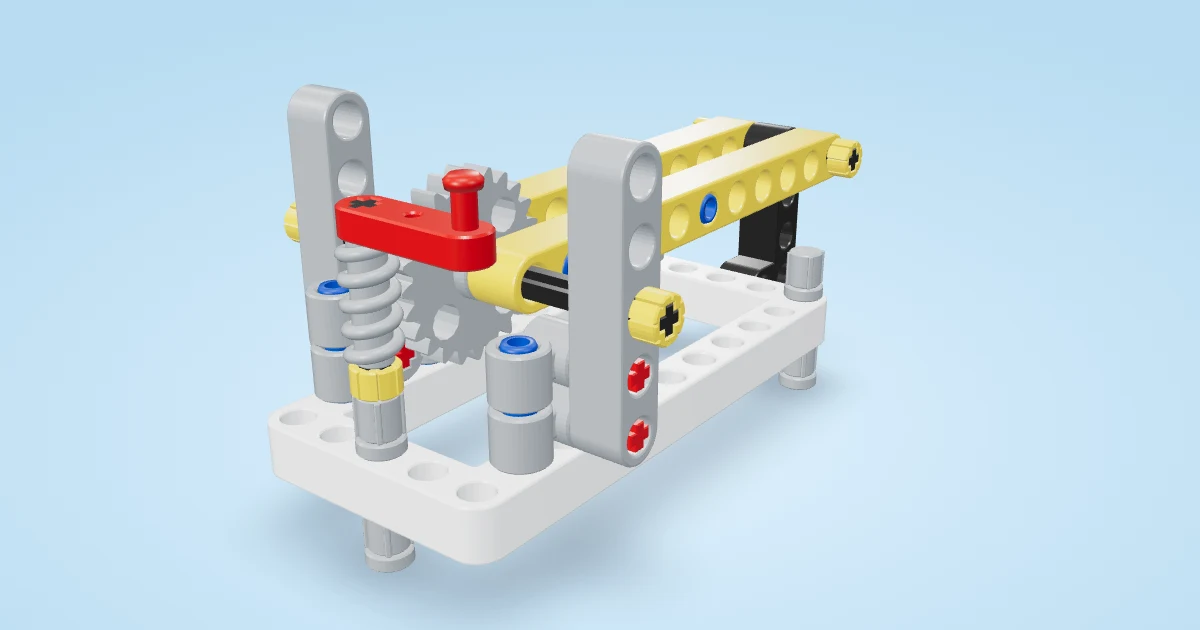
A worm gear is a screw that turns a gear. Each turn of the worm moves the gear on by one tooth, and the gear cannot push the worm round the other way. So a crane boom or a drawbridge driven by a worm stays exactly where you leave it when you let go of the handle. That "lock" is why worms show up in winches, lifts, gate openers and guitar tuning pegs.
This guide is about that lock: why it happens, when it fails, and the builds that rely on it. For the speed-for-strength side of worm gears (24 handle turns for one strong turn), see What is torque?, which has a winch lab with the same worm.
Before you start
Worm gears make most sense after a builder has met ordinary gears. If "a small gear driving a big gear turns it slowly" is new, start with the gears and gear ratio pages first.
One tooth per turn
Put a mark on the big gear and count turns of the worm until the mark comes back round. With the 24-tooth gear used in these builds, it takes 24 turns.
Build it: the Worm-Gear Crane (level 3, about 30 minutes) puts a worm on a crank next to a 24-tooth gear that tilts the boom. Its steps point it out as you build: each turn moves the big gear by just one tooth.
Why the gear can't turn the worm
Try it on the crane: let go of the crank and push down on the boom. Then try to turn the big gear with your fingers. The worm won't move.
The reason is the angle of the thread. A single-start worm's thread is only slightly slanted, by a few degrees. Engineers call that slant the lead angle. When you turn the worm, the thread slides along the gear teeth easily. When the gear tries to turn the worm, its teeth push almost straight into the side of the thread, and friction stops the thread sliding round.
A handy rule: a worm holds when its lead angle is no bigger than its friction angle. The friction angle grows with friction. Dry plastic has plenty of it, so the lead angle loses and the worm locks. Oil shrinks the friction angle, and a worm can start to slip.
Try it below: crank a load up, predict whether it stays when you let go, then release the handle.
Interactive: Worm lock tester. Crank a load up with spur gears, a single-start worm or a two-start worm, predict whether it stays up when you let go, then release the handle. Change the friction to see when a worm holds and when it slips, and play five scored challenges.
Two things the lab shows that surprise most people:
- Oil can undo the lock. The same worm that holds when dry can let the load creep back once it's oiled.
- More threads, less lock. A two-start worm has two threads side by side. It moves the gear two teeth per turn, which is faster, but its thread is steeper and it locks less easily.
The lock has a price, too. The same friction that holds the load wastes effort when you crank forwards, so a self-locking worm passes on less than half of your effort in the ideal model. This is why you feel a worm drive is stiff to turn even with no load.
Builds that use the lock
- Castle Drawbridge (level 2, about 30 minutes): a hand crank turns a worm, the worm turns a 24-tooth gear on the bridge's hinge axle, and the heavy bridge stays at whatever angle you stop at. It's a good first worm build because you can see what the gear is doing.
- Scissor Lift (level 3, about 45 minutes): a crank turns a worm, the worm turns a 24-tooth gear, and an 8-tooth pinion on the same axle slides a rack that opens two criss-cross X shapes. Ask: what holds the platform up when you stop cranking? Follow the parts back from the platform and you reach the worm.
- Worm-Drive Crawler (level 4, about 50 minutes): one L motor drives both axles through worm gears. Switch the motor off on a ramp and the crawler holds still instead of rolling back.
- Cog Railway Climber (level 4, about 55 minutes): a train that grips a toothed rail and climbs steep ramps. Because its motor drives through a worm, it can stop halfway up and stay there. Its build page lists the Worm-Gear Crane and Motor Buggy as builds to do first.
Test the lock on a real build
- Build the Worm-Gear Crane or the Castle Drawbridge.
- Raise the boom or bridge halfway and let go. Does it stay? Write it down.
- Hang a slightly heavier load and try again.
- Tap the frame gently a few times. Does anything creep? Vibration is one way real worm drives slowly slip.
- Now swap the worm for an 8-tooth gear driving the same 24-tooth gear (if your parts allow), raise it, and let go. Compare.
Common problems and fixes
- The worm slips over the teeth. It has drifted away from the gear. Bushes or half bushes on both sides of the worm keep it in place, which is why the crane's steps ask you to check that the worm touches the gear teeth.
- It is very stiff to turn. Some stiffness is normal (that's the friction that makes it lock), but an axle rubbing on a beam adds more. Check each axle turns freely before the worm goes on.
- The gear wobbles. It needs support on both sides. A bush squeezing the gear against the frame stops it sliding along the axle.
Check yourself
Interactive: Check yourself. A few quick questions on the ideas in this guide, each with an explanation.
- A single-start worm drives a 24-tooth gear. How many worm turns make the gear go round once?
- Why can the 24-tooth gear not turn the worm backwards?
- Which change makes a worm more likely to slip backwards?
- A two-start worm has two threads side by side. Compared with a single-start worm it…
- Why do real lifts with worm drives still have a brake?