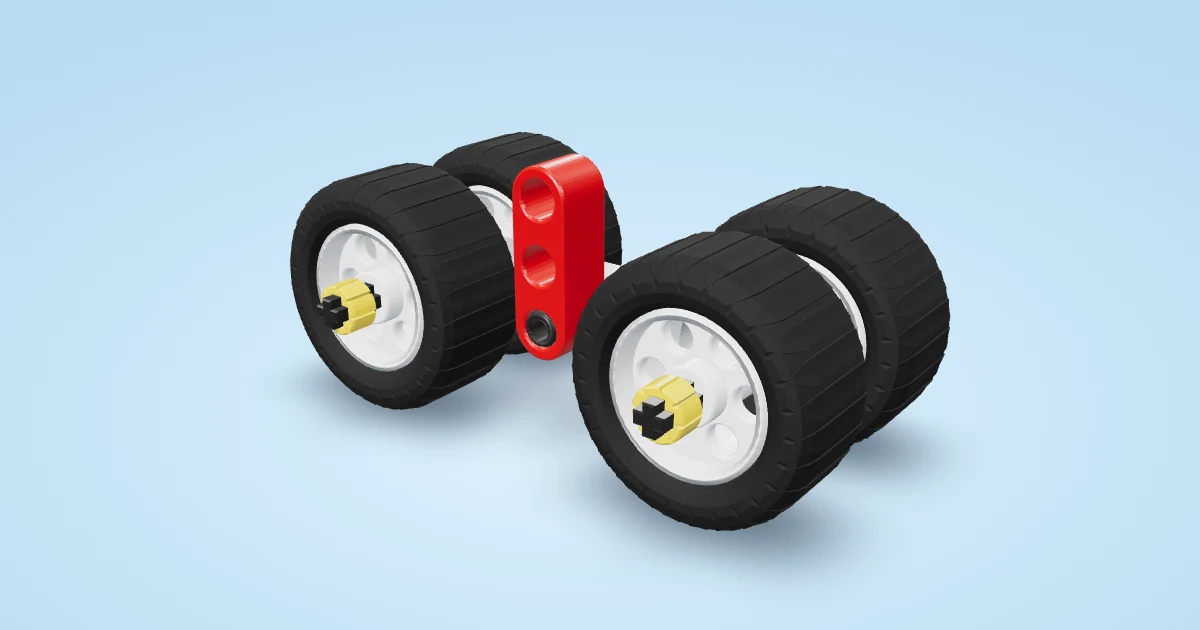
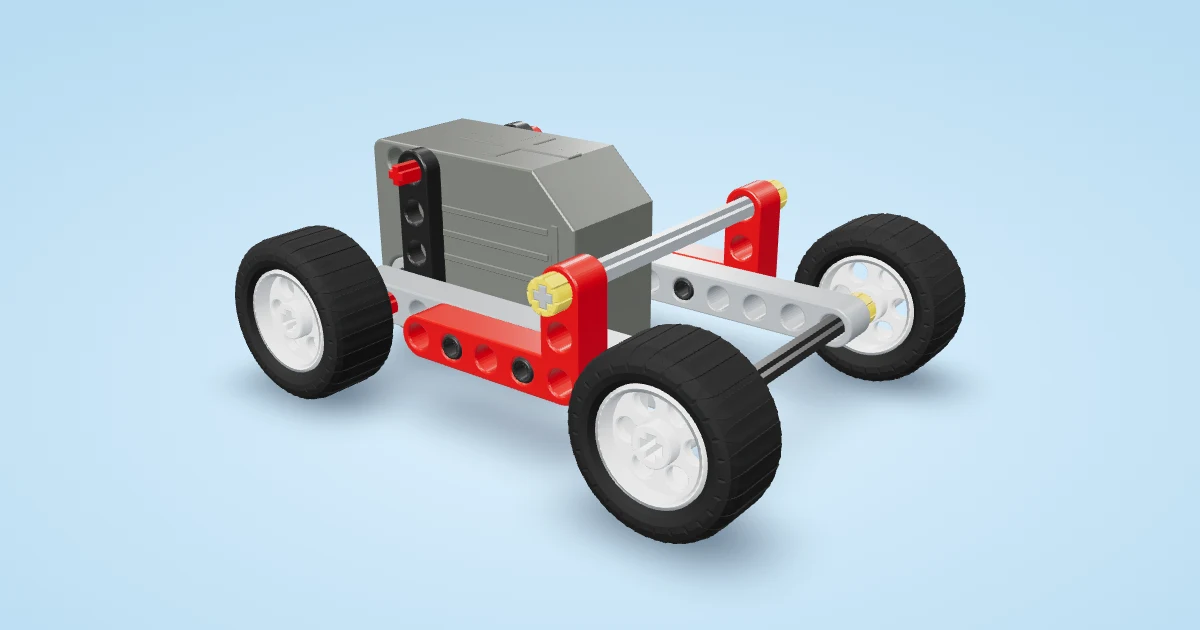
Choose Tiny Roller if you want a simple car to push, Pull-back Racer if you have the required pull-back motor, or Propeller Push Car if you want the wheels to drive a moving feature. Open the parts checklist before choosing. Each model has free animated instructions and an individual printable booklet.
The fastest useful check is the part that makes the model different. Four wheels do not tell you whether you can build a spring-powered racer. A pull-back motor does. Put that part on the table first, then compare the rest of the list. Compatible pieces may work, but check sizes and connections against the actual instructions.
Find your starting point
| What you want to try | Check these parts first | Free guide | Suggested time |
|---|---|---|---|
| Make a car roll when you push it | Wheels, axles and the short frame parts | Tiny Roller | About 5 minutes |
| Store energy and let the car drive itself | The pull-back motor plus wheels and frame parts | Pull-back Racer | About 12 minutes |
| Make the wheels turn propellers through gears | The specified gears and propeller parts | Propeller Push Car | About 12 minutes |
Times are guide estimates. Sorting pieces, learning a new connection and changing parts can add time. Use the parts guide to identify a piece, and check the full list in the chosen booklet before buying anything.
Interactive: Check and prepare your parts. Compare the parts for your first car or calculate a classroom inventory.
Start with Tiny Roller when you want a quick result
Tiny Roller has 13 pieces and introduces the relationship between a wheel, its axle and the frame. It is a good first choice when you want to practise connecting a small model and immediately see it move. You supply the push.
After assembly, turn a wheel gently while holding the frame. Look for a wheel rubbing against a beam. Put the car down and compare a gentle push on a smooth surface with the same kind of push on carpet. Predict which run will stop sooner. Repeat each run three times before deciding whether the surface made a consistent difference.
The axles and wheels explanation helps you identify what rotates. If a wheel comes loose or the axle shifts, return to the relevant assembly step and compare the retaining parts. Fix the connection before trying a stronger push.
Choose Pull-back Racer when you have its motor
Pull-back Racer uses 28 parts. Its spring motor stores energy when you roll it backwards. Place it on a clear floor, roll it back a short distance and release it. Stop winding when the motor reaches its limit. Keep fingers and loose items away from moving wheels.
Use the full checklist to compare the motor and frame connections with your pieces. A battery motor has a different input and needs its own guide. If your motor does not match, return to Tiny Roller and practise the rolling frame first.
Once the racer works, mark one start line and measure the distance from that line to the same point on the car after each run. Keep the surface and pull-back distance fixed. Three runs show you whether the result is repeatable. The pull-back car experiment supplies a results table and further questions.
Choose the propeller car to explore gears
Propeller Push Car uses your push to turn the wheels and drive propellers through gears. The propellers are a visible output you can watch while the car moves. They are not a claim that this model flies.
Before assembly, find the specified gear sizes and follow their axle positions in the instructions. Mark one wheel and watch the propellers as you roll it slowly. Predict whether the visible output turns faster than the wheel. The model's designed ratio makes the propellers turn three times faster.
Try a gear pair below. Choose the tooth counts, predict the output turns for one input turn and check the result. An ideal ratio describes rotation. A real car also has rubbing surfaces, tyre grip and alignment to consider.
Interactive: Gear pair simulator. Pick a driver and a driven gear, turn the input and watch both gears mesh. The ratio, output turns and direction update as you go, and a worksheet checker sets fresh questions.
Read the gear-ratio guide if you want to calculate the turn count. Return to the model and point to the input and output before starting another run.
Keep the right booklets for your activity
The Starter Builds pack groups the Tiny Roller and Pull-back Racer booklets with the starter series. Propeller Push Car belongs to the Gearbox & Drivetrain Cars pack. Each individual model also has a free PDF in its build guide. Check the current pack contents on the booklet page when choosing a bundle for repeated sessions.
Finish one small test before choosing the next car
Write down the model, surface, input and what you observed. “It went farther” becomes more useful when you record the start line, pull-back distance and three measured results. Change one thing for the next test.
Keep the free booklet for the car you built. For another activity, choose a question you can check with your existing parts. The beginner collection offers more short builds and the car collection lets you explore different ways of powering and steering a vehicle.
Interactive: Check yourself. A few quick questions on the ideas in this guide, each with an explanation.
- Which part should you check before choosing Pull-back Racer?
- What powers Tiny Roller?
- How should you compare two floor surfaces?