Technic-style parts (beams with holes, pins, axles and gears) look harder than ordinary bricks, but they are approachable with a few basic techniques. The trick is to start with a model that is finished in one sitting and does something the moment the last part goes on. A rolling car or a pair of gears that turn each other is enough. A first build that moves beats a big build that stays on the table half done.
These six builds are the ones we suggest for beginners, in the order we would do them. Each one has an animated step-by-step guide and a free printable booklet.
1. Tiny Roller (about 5 minutes)
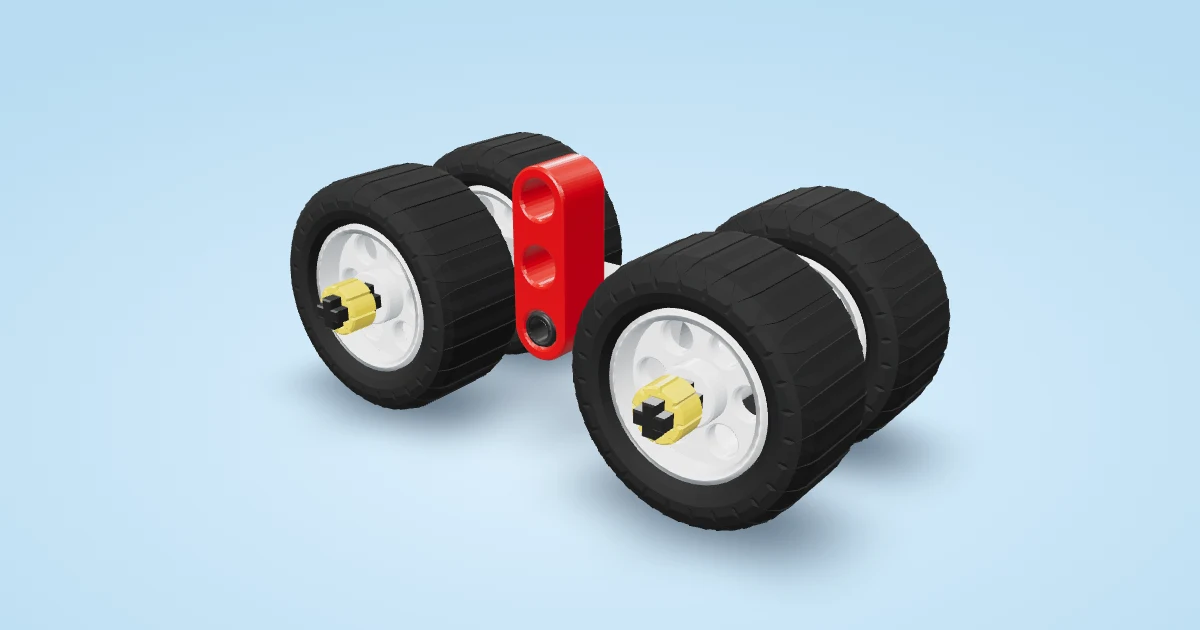
Tiny Roller is two axles, four wheels and a couple of beams. It is the smallest thing that rolls, and it teaches the most important idea in the whole set: a wheel turns on an axle, and the axle goes through a hole in a beam. Push it across the floor, then ask your building partner why the wheels don't fall off. The answer (the axle is held on both sides) is the start of how axles and wheels work.
2. Gear Friends (about 8 minutes)
Gear Friends puts three gears in a row on a frame. Turn the first one and the others turn too. It is satisfying to discover that the middle gear turns the other way. That is a real engineering idea, idler gears, and they discover it with their own hands before anyone names it.
3. Pendulum Metronome (about 10 minutes)
Pendulum Metronome needs no batteries: gravity does the work. Swing it and count the ticks. Then move the wheel on the arm and count again. When the weight sits further from the pivot it swings more slowly, and closer in it swings faster, which makes a straightforward first fair test. The pendulum page has the explanation in plain language.
4. Balance See-Saw (about 12 minutes)
Balance See-Saw turns a beam on a pin into a balance. Put a small part on one end and ask: where do you need to put a bigger part to make it level? Builders find out that a light thing far from the middle can balance a heavy thing close to it. That is how levers work, and it is the same idea behind cranes and playground see-saws.
5. Push Buggy (about 15 minutes)
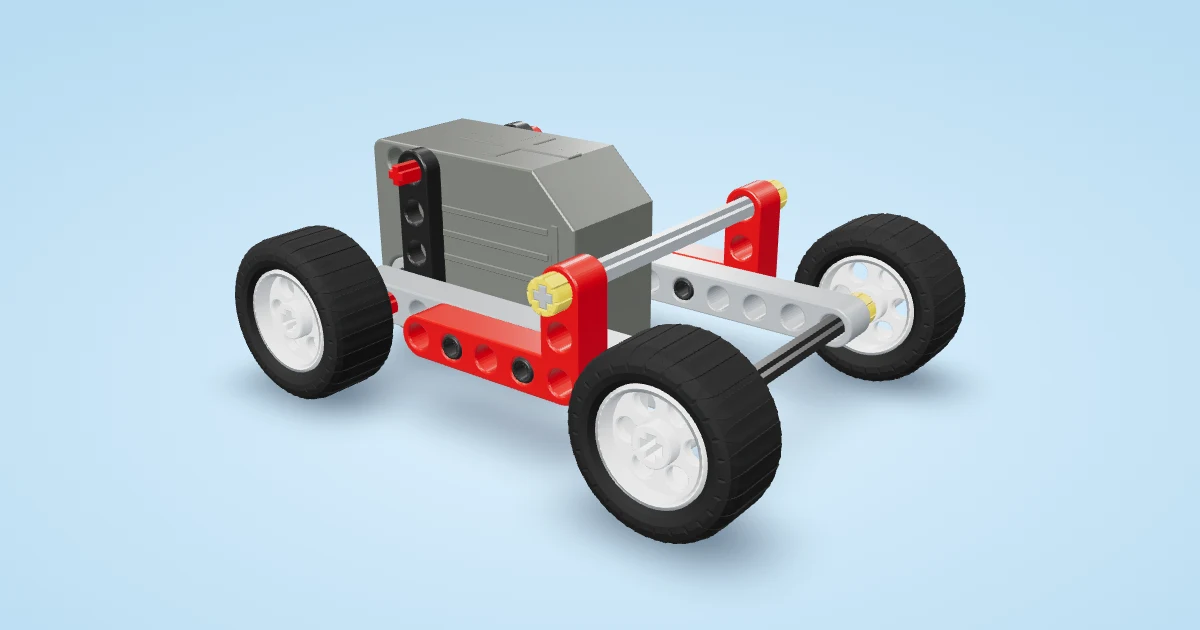
Push Buggy is the first build with a proper chassis. It introduces bushes, the little collars that stop axles sliding out, and triangles that stop a frame from bending. If the buggy wobbles, that is a lesson too: add a triangle and feel the difference.
6. Pull-back Racer (about 12 minutes)
Pull-back Racer is the one everybody remembers. Pull it back, let go, and it shoots across the room. It uses a pull-back motor, which winds a spring inside when you roll it backwards. Try a short pull and a long pull and mark where it stops each time: that is stored energy, measured with a strip of tape on the floor.
Not sure which one to start with?
Answer three quick questions below: how long you have, what kind of motion makes your builder grin, and whether there is a pull-back motor in the box. The finder picks one of the six builds, with its real time and number of steps, and suggests what to try next.
Interactive: First build finder. Answer three quick questions about time, the kind of motion your builder loves and the parts on hand, and get the first build to start with and the one to try next.
How to help without taking over
- Sit next to them, not opposite. The animated steps are easier to follow when you both see the same view.
- Let them find the parts. Finding "the grey beam with 7 holes" is half the learning when getting started. Count holes together if needed.
- Press, then check. Pins need a firm push. After each step, ask your building partner to give it a gentle wiggle: if it moves, something is not pushed in.
- Stop while it is still fun. Ten minutes of building and five minutes of playing is a great session. The next build will still be there tomorrow.
- Talk about what it does, not what it is called. "Why does this gear go the other way?" works better than "this is an idler gear".
What parts do you need?
The builds were designed with compatible Technic-style parts: beams, pins, axles, gears, wheels and a pull-back motor. My parts lists every part with a picture, and each build page shows its own parts list before you start, so you can check you have everything. If a part is missing, the builds without a motor are a good place to look for a swap.
Interactive: Check yourself. A few quick questions on the ideas in this guide, each with an explanation.
- Why does a first build that moves work better than a big build?
- In Gear Friends, which way does the middle gear turn when you turn the first one?
- On the Pendulum Metronome, the wheel is moved further from the pivot. What happens to the swing?
- A pin has just been pushed in. What is the quickest check?
Where to go next
After these six, builders can try level 2 and 3 projects at their own pace: a steering go-kart, a worm-gear crane or the gear speed lab. The easy first builds list and the learning path keep everything in a sensible order, so you never have to guess what comes next.