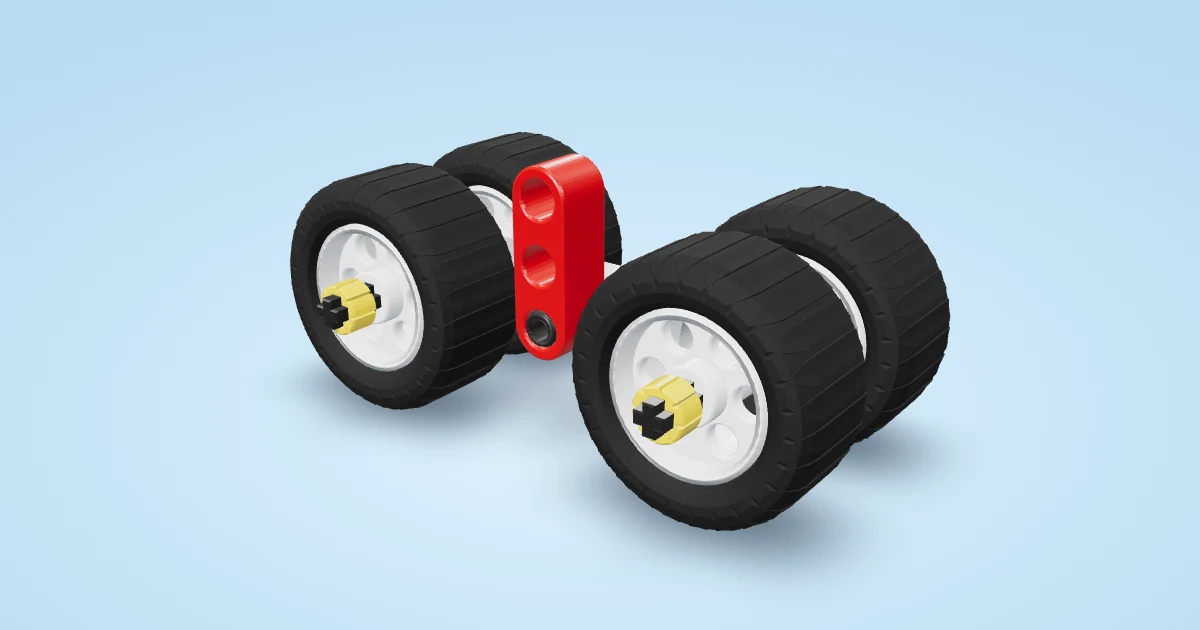
No: a steeper ramp doesn't make a car roll further, as long as the top of the ramp is at the same height. The height decides how much energy the car starts with, and the floor's rolling resistance decides how quickly it is used up. A steeper ramp gets the car to the bottom sooner, not faster. Change the height, though, and the distance changes in step: twice the height, about twice as far.
Most people predict the opposite, which makes this one of the best first experiments to run with a Technic-style car.
The rule in one line
roll-out distance ≈ ramp height ÷ the floor's drag number
The drag number is what engineers call the coefficient of rolling resistance: the share of the car's weight that the floor pushes back with as the wheels roll. A hard, smooth floor has a small number. A soft carpet has a bigger one, because the pile squashes under the wheels and soaks up energy, the same reason a real car rolls less easily on sand than on concrete.
Notice what isn't in the rule: the car's weight and the ramp's angle. A heavier car has more energy at the top, but it also presses harder on the floor, and the two cancel out. That is a second surprise worth testing.
Try it in the lab first
Set the ramp's height and length, choose a smooth or rough ramp surface and a floor, then predict how far the car goes. The challenges walk through the classic mistakes.
Interactive: Ramp roll-out lab. Roll a car down a ramp onto the floor: change the ramp’s height and length and the drag numbers of the ramp and the floor, then predict how far it rolls. Five challenges: does a steeper ramp send it further, what does doubling the height do, and how to measure your floor’s drag number.
When the angle does matter a little
A real ramp has its own drag. A long, gentle ramp gives that drag more distance to work on, so the car arrives at the bottom with slightly less energy. With a rough ramp the steep one wins by a little, not by a lot: in the lab, about 91 cm against 81 cm. Very gentle rough ramps can stop the car before it even reaches the floor.
There is also a small loss at the bottom, where the car bumps from the slope onto the floor. A gentle bend helps: a sheet of card curved from the ramp onto the floor makes results steadier.
Run the experiment
You need a Technic-style car, a board, some books, a tape measure and a floor or two.
The Tiny Roller (level 1, about 5 minutes) is ideal: 13 pieces, four small wheels, nothing to wind up. Its own play note asks the right question: give it a gentle push and see how far it rolls. Here we use a ramp instead of a push, so every run starts the same way.
- Set the height. Stack books under one end of the board so its top edge is 10 cm off the floor. Measure the height, not the length.
- Release, don't push. Hold the car with its back wheels at the top edge and let go. A push adds energy you can't measure.
- Measure the roll-out from the bottom of the ramp to the car's back wheels. Do three runs and use the middle value or the mean.
- Change the angle, not the height. Move the books closer so the same 10 cm height makes a steeper ramp. Three more runs. Did the distance change?
- Change the height. Make it 20 cm. Three more runs. Close to double?
- Measure your floors. Work out a drag number for each surface: height ÷ roll-out. Tile, wood, a rug, a towel. Rank them.
If your three runs disagree a lot, look for the cause before you average: a wheel rubbing on a half bush, a crooked start, the car hitting something. The pull-back car experiment has a results log that works out the median, mean and range for you and flags runs worth repeating.
Try a heavier or bigger car
- The Push Buggy (level 2, about 15 minutes) is heavier and has bigger wheels. Run it from the same 10 cm height. If the rule holds, weight alone shouldn't change much; any difference points to its wheels and axles.
- The Flywheel Friction Car (level 2, about 25 minutes) stores extra energy in its spinning flywheel wheels when you rev it up. Rolled down a ramp without revving, part of the ramp's energy goes into spinning that flywheel, which it gives back later. Does it roll further, or just take longer?
For why a free-spinning wheel slows down at all, from bearing friction and drag, see why a hand-spun wheel slows down. The Friction idea page has the short version.
Check yourself
Interactive: Check yourself. A few quick questions on the ideas in this guide, each with an explanation.
- Two ramps start at the same height. One is steep, one is gentle, both smooth. Which car rolls further across the floor?
- You double the height of the ramp. Roughly how far does the car roll now, on the same floor?
- From a 10 cm ramp, a car rolls 50 cm on a rug. What is the rug’s drag number?
- Why might a car on a long, rough ramp roll less far than on a short, steep one of the same height?