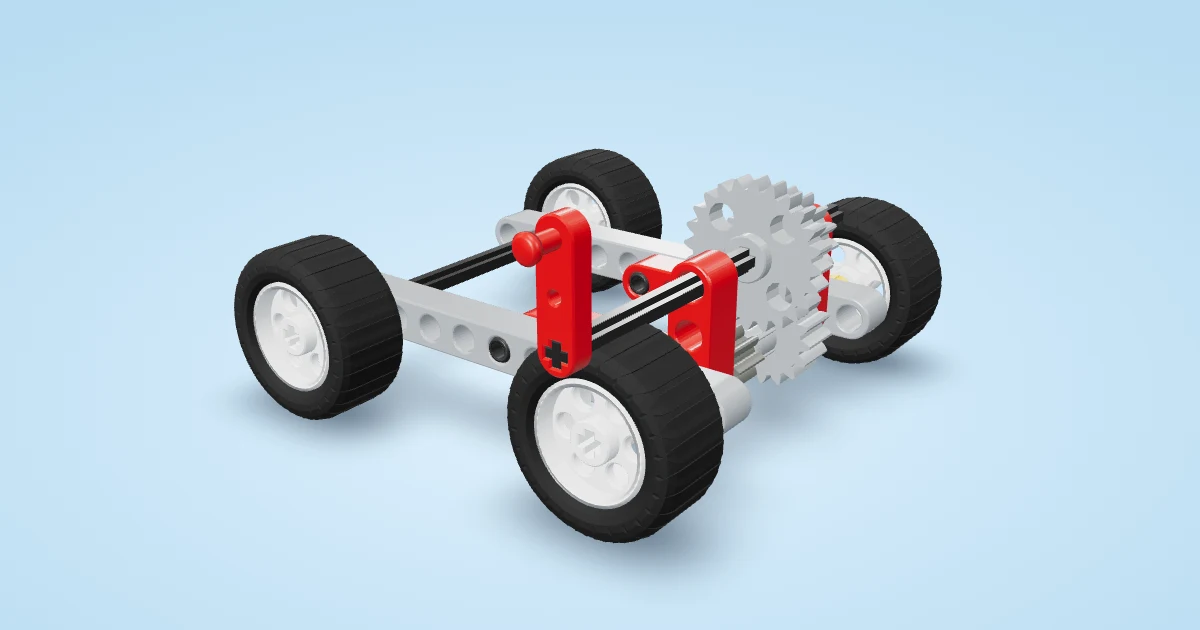
A two-speed gearbox lets the same input drive the wheels at two different rates. Count the wheel turns for one input turn before racing the car: that gives you a direct check of the mechanism. Then compare a flat-floor run with a gentle ramp. The faster setting on the floor may be the weaker setting on the ramp.
Start with a mechanism you can see
The Sliding-Gear 2-Speed Cart is a hand-cranked starting point. Its two pairs are 16 teeth driving 16 teeth, and 24 teeth driving 8 teeth. The first pair gives one output turn per input turn. The second gives three output turns per input turn. Because you supply the input by hand, you can stop at any point and inspect which gears touch.
Check the parts list before starting. The animated instructions show the intended assembly, but do not replace checking that your actual axles turn freely. Push bushes close enough to retain the axles without squeezing a rotating gear against the frame. If the mechanism binds, fix that before comparing ratios.
Count turns before measuring speed
Put a small removable mark on one wheel and another on the crank. Lift the driven wheels clear of the table. With the first gear selected, turn the crank exactly once and count the wheel rotations. Repeat slowly three times. Select the other gear and repeat the count.
Write down the selected gear, input turns and output turns. If the counts do not match the intended ratios, inspect the selected gear pair. A sliding axle that sits between its intended positions may not mesh properly. A gear that turns without its axle may have been placed on the wrong shaft or may not be engaged by the driving ring.
This check tests the gear ratio, not the car's top speed. Actual road speed also depends on how fast the input turns, wheel diameter, losses and load. A hand crank does not provide constant power, so do not claim an exact speed improvement from a hand-cranked race.
Understand what torque means
Torque is turning effort. A reduction makes the output slower and increases its available turning effort in an ideal gear train; real friction reduces that benefit. A speed increase does the reverse. Neither setting creates extra energy.
For a motor-driven comparison, try the Clutch-Gear 2-Speed Car. Its gearbox uses an 8-tooth gear driving a 24-tooth clutch gear for reduction, and a 16-tooth pair for direct drive. These ratios differ from the hand-cranked cart. Read each build's own instructions instead of assuming every lever position has the same meaning.
Try both builds in the shifter below. Turn the input exactly once in each gear and count, then take each gear on a flat sprint and up a book ramp. The lever refuses to move while the gears turn, just like the real model.
Interactive: Two-speed gearbox shifter. Shift between the two gears of a real build, turn the input and compare wheel turns with ideal relative turning effort.
Separate the clutch from the gearbox
A gearbox selects a ratio. A clutch and driving ring engage a drive connection. In the Clutch-Gear 2-Speed Car, gears can spin freely until the ring locks one to the output axle. A larger demonstration may also use a separate clutch to disconnect the motor while shifting; that is a different arrangement.
Stop the motor before changing gear unless the build's instructions explicitly provide another procedure. Do not force a ring into a rotating gear. Inspect engagement by turning the mechanism gently by hand, with electrical power off, before powering the car again.
Run a repeatable comparison
Mark a start and finish line on a smooth floor. Use the same car, wheels, surface and battery condition for both settings. Start from rest, time the trip, and repeat three times per setting. Alternate settings so a weakening battery does not affect only the last group of runs.
Next use a short, supported ramp with a clear landing area. Keep its height fixed. Record whether the car reaches the top, stalls, spins its tyres or tips. Those are different outcomes. A reduction can help a motor that struggles to turn the wheels, but cannot guarantee grip when the tyres are already slipping.
Before you head to the floor, check the ideas with four quick questions.
Interactive: Check yourself. A few quick questions on the ideas in this guide, each with an explanation.
- On the Sliding-Gear 2-Speed Cart, a 24-tooth gear drives an 8-tooth gear. How many wheel turns for one crank turn?
- The Clutch-Gear 2-Speed Car’s 1st gear is an 8-tooth gear driving a 24-tooth clutch gear. Compared with 2nd (16 to 16), 1st gear gives…
- Your car stalls halfway up the book ramp in the fast gear. What should you try first?
- Does a lower gear give the car extra energy?
Try a spring-powered version
The Two-Speed Pull-back lets you compare two settings without a battery. Use the same pull-back distance and release point for each run. Stop winding if the spring mechanism reaches its limit; extra winding does not make a fairer test.
Keep the results as observations from your own model. MightyCog's build movies are 3D assembly animations, not evidence that a physical car achieved a particular speed or climbing angle. The linked creator demonstrations show more elaborate machines; this guide teaches the underlying idea on smaller builds rather than reproducing their vehicles.