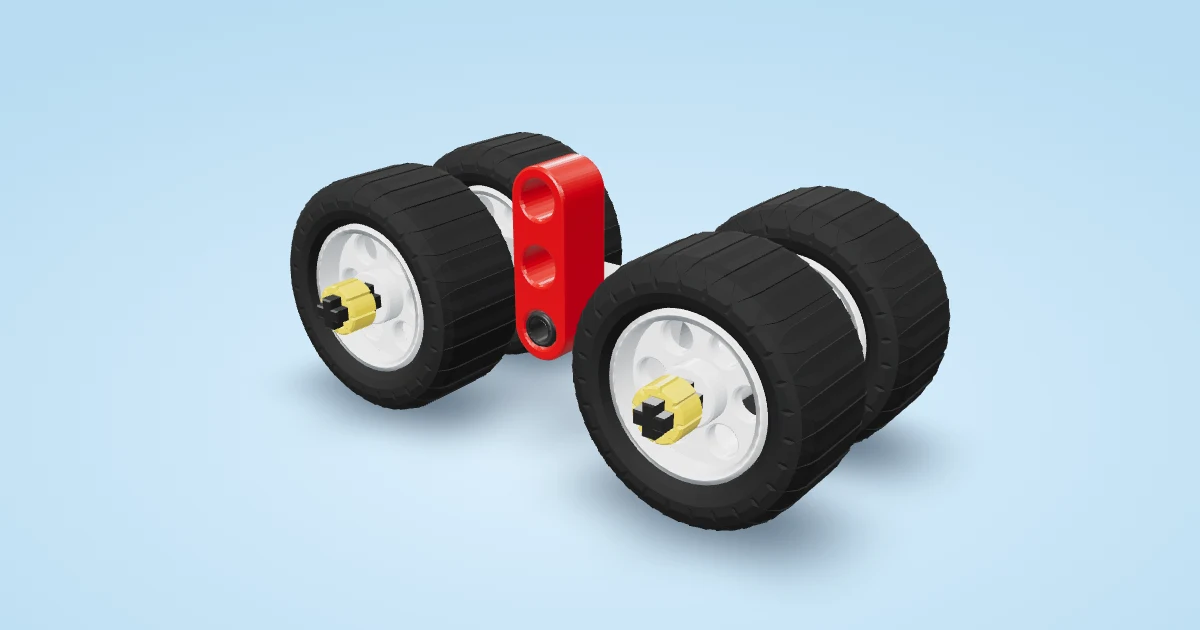
Larger wheels do not make more turns when both wheels grip the same rigid axle. They share the axle’s angle and revolutions per minute. A point on the larger rim does travel farther around its circle during each turn, so its speed in millimetres per second is greater. Equal turns and equal distance are different claims.
Two wheels finish together, but their rims take different paths
Imagine two runners completing one lap together on different-sized circular tracks. They finish at the same time, but the outer runner covers more distance. That is the useful surprise in our new Rim Distance Bench: one shaft, two unequal wheel diameters, and a comparison you can make with gentle hand turns.
Brick Experiment Channel’s credited spinning-wheel demonstration inspired the question about what a rotation number means. Its description and inspected footage show a powered speed experiment, not complete part-by-part assembly instructions. Our original bench is a different educational model. It has no motor, speed-increasing gears or speed-record goal. We use the rotation idea to compare circular paths; we do not reproduce the creator’s machine, its results or its operating speeds.
The bench uses 23 compatible parts in nine steps, with an estimated fifteen-minute build time. A five-hole bearing bridge is fastened to a flat frame with two separated friction pins. Four retained feet support the base. A vertical axle passes through the bridge, with half bushes immediately above and below to prevent axial escape. A yellow-hub wheel and a thin-tyre wheel sit on the same shaft, separated and retained by further half bushes. Their cross-shaped hubs follow the axle together. That common connection is the point of the experiment.
Count a turn before measuring its distance
Use two small removable marks, one on each rim. Set both beside a fixed visual reference while the shaft is stationary. Hold the frame level and turn the exposed axle gently through one complete revolution. Both marks return together. Half a turn puts both marks opposite their start; a quarter turn advances both through ninety degrees. Do not compare the number of spokes flashing past, because different hub patterns can make equal rotation look unequal.
The nominal outside diameters in our part model are 43.2 mm and 30.4 mm. A full circular path is the circumference: π × diameter. One ideal turn therefore traces about 135.72 mm around the larger rim and 95.50 mm around the smaller one. Both still make one turn. The distance ratio is 43.2 divided by 30.4, about 1.42, while the turn-count ratio remains one.
At ninety degrees the path is one quarter of the circumference: about 33.93 mm and 23.88 mm. A rim mark ends closer to its start than those distances suggest because the path bends. Do not measure a straight line between the start and end points and call it the circular path. After one full revolution the mark returns to its starting position, but it has traveled a whole circumference, not zero distance.
Predict, change one variable, then explain
Enter 135.72 mm as the larger wheel’s predicted one-turn distance and check it. Move the common-angle slider to ninety degrees, then to 360 degrees. Watch the equal turn count beside the unequal path readouts. The two schematic circles are drawn apart for clarity; the actual bench stacks its wheels.
Interactive: Equal turns, unequal rim paths. Two unequal wheels on one shaft have equal turns but rim distances proportional to diameter. Predict circumference, scrub the shared angle, compare millimetres and rim speed, and reset. Ideal circles, not a vehicle or physical speed test.
Next set both virtual diameters to 30.4 mm. The paths become equal without changing the axle angle. Restore 43.2 mm for wheel A and keep the angle fixed while changing the chosen rpm from ten to twenty. The path for that angle stays the same, but the displayed rim speed doubles. Distance depends on how far you turn; speed also depends on how long the turn takes. The alternative virtual diameters are comparisons in an ideal circle model, not instructions to fit larger wheels into this bench.
RPM means revolutions per minute. At ten rpm a wheel makes one sixth of a turn each second. Multiply its circumference by ten divided by sixty to get rim speed: about 22.62 mm/s for the larger wheel and 15.92 mm/s for the smaller one. Those are calculations using chosen speed and nominal dimensions. The slider does not measure your hand or control the build animation. No timed waiting or fast spinning is needed to learn the relationship.
A fair circumference worksheet
First verify both hubs follow the shaft and neither wheel rubs the bridge or the other tyre. Stop if a retainer moves or anything feels loose. For a physical circumference comparison, use a narrow paper strip around each stationary tyre, mark where the ends meet, then flatten and measure the strip with a ruler. Use light, consistent tension. Repeat three times and record uncertainty from tread, overlap and ruler divisions. Keep the parts and measurement method the same throughout.
| Trial | Larger tyre circumference, mm | Smaller tyre circumference, mm | Larger / smaller | Measurement notes |
|---|---|---|---|---|
| 1 | Record | Record | Calculate | Record |
| 2 | Record | Record | Calculate | Record |
| 3 | Record | Record | Calculate | Record |
These cells are deliberately empty: we have not physically tested the bench. Compare your measurements with the nominal predictions and explain differences rather than editing the measurements to match π. A flexible tyre with tread is not a perfect rigid circle. A careful uncertainty note is more useful than claiming hundredths of a millimetre from a coarse ruler.
Common mistakes and useful next builds
- The larger wheel looks faster. Track one removable mark on each wheel, not spokes or blur. Equal angles can coexist with unequal rim speed.
- A wheel lags behind its partner. Check the cross-shaped hub and shaft connection. Hub slip breaks the common-angle assumption; it is not an effect of diameter.
- The shaft lifts or rubs. Review both bearing retainers, wheel spacers and the two-pin bridge. Fingers should steady the stationary frame, not replace missing shaft support.
- A calculation becomes a car-speed claim. This bench stays on the table. A rolling wheel needs separate contact and slip assumptions, and its loaded effective radius can differ from its unloaded outside radius.
Build the free Rim Distance Bench instructions to inspect those supports in the animated steps and printable booklet. Then try Tiny Roller for actual rolling, or Odometer Cart to connect wheel turns with a counting mechanism. The Axles & Wheels guide explains the shared connection, while Bushes explains why a rotating shaft still needs retainers. Explore the free build catalogue when you want a different challenge.
Interactive: Check yourself. A few quick questions on the ideas in this guide, each with an explanation.
- A 43.2 mm wheel and a 30.4 mm wheel grip one rigid axle. Which makes more turns?
- For one complete turn, what is the ideal path around the 43.2 mm rim?
- Both wheels turn at 10 rpm. Which rim point has the greater speed in mm/s?
- Does this bench’s rim-speed calculation prove how fast a car will go?