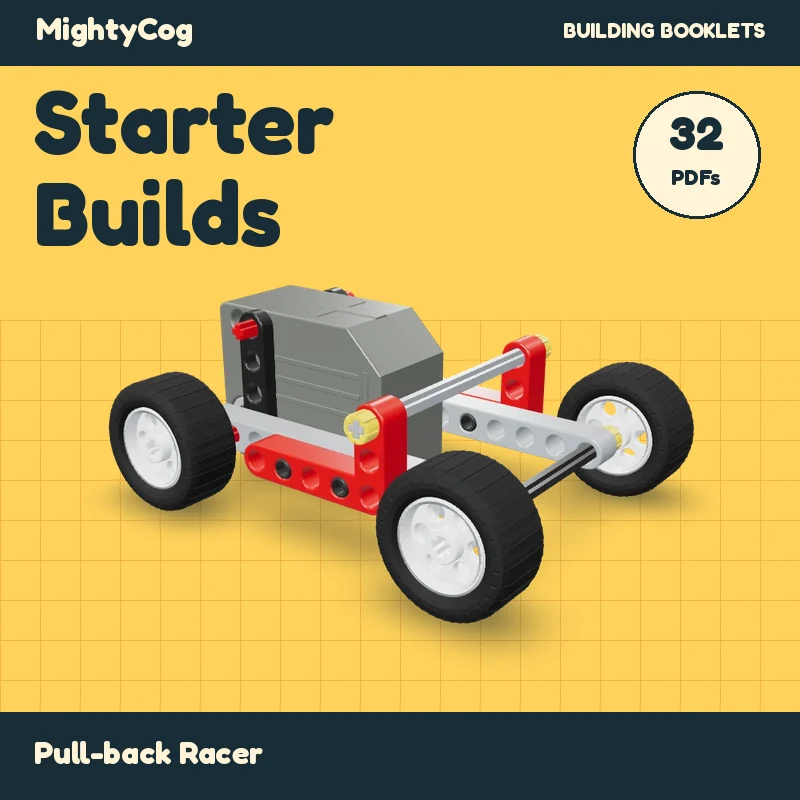
A car drives straight only when both sides cover the same ground. If the left side travels even slightly further than the right, the car turns right, and that small turn keeps adding up. A 1 mm difference in wheel size on the Motor Buggy puts it about 34 cm off line after 2 metres.
Check these five causes in order:
- Wheels that don’t match on a solid axle
- A crooked start
- Two motors that don’t match, one per side
- Something rubbing on one side
- Steering that isn’t centred, on cars that steer
1. Wheels that don’t match
The Motor Buggy’s back axle is one solid axle: one M motor turns it through an 8-tooth gear and a 24-tooth gear, with a 56 mm wheel on each end. Both wheels must turn at the same rpm. If one rolls on a slightly smaller diameter, it covers less ground every turn, so the car curves towards the smaller wheel.
The surprise is how fast it adds up. The two wheels are 13.3 holes (about 106 mm) apart, so a 1 mm difference puts the car on a circle with a radius of about 5.9 m. That doesn’t sound like much of a curve, but after 2 m the car is already 34 cm off line, and after 4 m well over a metre.
Check: put the same kind of wheel and tyre on both ends, push each tyre fully onto its hub, and use the same wheel on both sides if your kit has two kinds.
2. A crooked start
Set a perfectly good car down 5° off line and it ends up about 17 cm off after 2 m. The difference is that it travels in a straight, slanted line, while mismatched wheels make a curve that keeps getting worse.
Check: tape a line on the floor and mark where the car is after 1 m and after 2 m. With a crooked start, the second mark is twice as far off as the first. With a curve, the second mark is about four times as far off.
3. Two motors that don’t match
Tanks steer by running their two tracks at different speeds, so any speed difference between the tracks becomes a turn. Our RC Tank drives its left track with an M motor and its right track with an L motor, each straight onto a sprocket.
Philo’s measurements at 9 V give the M motor 405 rpm with no load and the L motor 390 rpm, so with no load the tank curves right, about 80 cm off line after 2 m. But the L motor is much stronger: Philo measured stall torques of 11 N·cm for the M and 18 N·cm for the L. Under load, the M slows down more. At 2 N·cm each, the straight-line estimate gives about 331 rpm for the M and 347 rpm for the L, so now the tank drifts left. The motor myths post explains these speed–torque lines.
Even two motors of the same type differ slightly. On a Eurobricks thread about a tank turning to one side, one builder noted that motors from the same factory still differ, and another suggested swapping the motors: if the drift swaps sides too, the motors are the cause. With a remote, the driver simply steers to correct it. Our tracks vs wheels post covers how skid steering turns on purpose.
Try it: predict the path
Change one wheel, one motor or the start angle, and see the path from above:
Interactive: Drive straight lab. Give the Motor Buggy one slightly smaller back wheel, aim it a few degrees off, or swap the RC Tank’s M and L motors and change their load, and see the path from above: which way it curves and how far off the line it ends up. Five predict-then-check challenges.
4. Something rubbing
A wheel pressed hard against a bush, a tyre touching the frame, or a tight track drags on one side. On a tank that slows one track. On a solid axle both wheels still turn together, but the drag tries to twist the car towards the dragging side. Another piece of advice in the same Eurobricks thread was to check that everything moves freely, track links included.
Check: lift the model and turn each wheel and track by hand. Nothing should grind or catch, and wheels that aren’t driven should coast for about the same time on both sides. Our hand-spun wheel post shows how much a little rubbing slows a wheel down.
5. Steering that isn’t centred
On a car with steering, a front wheel pointing slightly to one side does the same job as a crooked start, on every metre. Some toy RC cars have a small steering adjuster underneath for exactly this, as one iFixit answer describes. On a Technic-style model, check that the steering is in its middle position before each run.
A five-minute test
| Run | Off line at 1 m | Off line at 2 m |
|---|---|---|
| As built | ||
| Wheels swapped | ||
| Motors swapped |
Change one thing per run, three runs each. If you are new to motors, start with the first motor build guide.
Interactive: Check yourself. A few quick questions on the ideas in this guide, each with an explanation.
- On a solid axle, one wheel is slightly smaller than the other. Which way does the car curve?
- How can you tell a crooked start from a curving car?
- The RC Tank has an M motor on one track and an L motor on the other. Why can it drift either way?
- A tank drifts. You swap its two motors over and now it drifts the other way. What does that tell you?