A radar finds a plane in two separate steps. It sends out a short radio pulse and times the echo: the pulse travels out and back at the speed of light, so distance = speed of light × echo time ÷ 2. And it turns its dish to point that pulse all the way round, so how fast the dish turns decides how often it looks in each direction. A plane 30 km away echoes back in 200 millionths of a second, but an airport radar only looks its way once every 4.8 seconds.
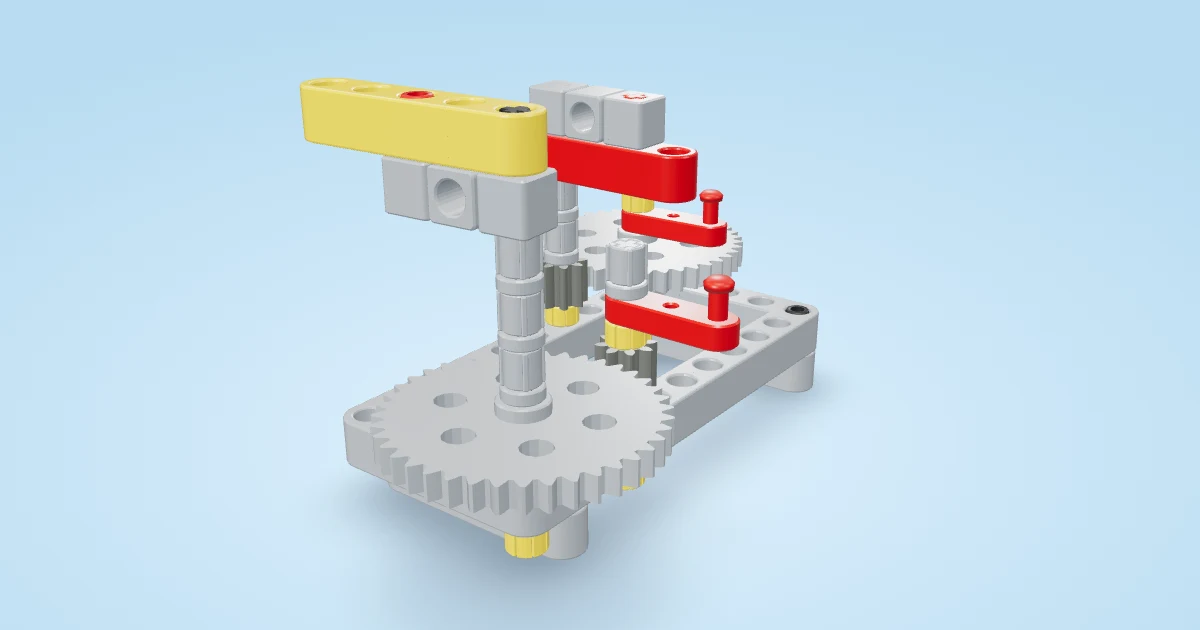
Our Spinning Radar (level 3, 38 parts, 15 steps, about 25 minutes) builds the second half: a motor-driven dish that sweeps round on a turntable. It can’t send pulses, but it is a good way to see why the turning part matters and to practise the maths for both.
How does a radar measure distance?
The radar sends a brief pulse of microwaves and listens. Anything in the beam, such as a plane, reflects a tiny part back. Microwaves travel at about 300,000 km per second, so the time until the echo arrives tells the radar how far the pulse went. It went there and back, so the target is at half that distance:
| Plane’s distance | Out and back | Echo time |
|---|---|---|
| 15 km | 30 km | 100 microseconds |
| 30 km | 60 km | 200 microseconds |
| 60 km | 120 km | 400 microseconds |
Twice as far, twice as long. That straight line from time to distance is the heart of every radar.
Why does the dish turn?
A radar dish focuses its pulses into a narrow beam, so it only “sees” in the direction it points. To watch the whole sky, it turns. The ASR-9 airport radar turns at 12.5 rpm, so it looks in each direction every 4.8 seconds. Airport surveillance radars must spot aircraft out to 60 miles. Slower long-range radars update about every 12 to 13 seconds.
Between looks, a plane keeps flying. At 900 km/h, 250 metres a second, an airliner moves about 1.2 km between two looks of the ASR-9 and about 3 km between looks of a radar turning once every 12 seconds. That is why the blips on a radar screen jump along in steps.
Try both ideas in the lab. The beam on the screen turns at each radar’s real speed. Change the plane’s distance and the echo time changes; change the radar and the time between looks changes. One never affects the other.
Interactive: Radar sweep lab. A radar screen with a beam that turns at real speed: compare the Spinning Radar model with an airport and a long-range radar, and predict the time between looks, the echo time for a plane’s distance and how far a plane moves between updates. Five challenges.
How does the Spinning Radar turn its dish?
An M motor sits upside down on two pins in a flat beam. A short axle pushed up through the beam into the motor carries a tiny 8-tooth gear, which drives a 40-tooth gear on a tall 10-long mast standing in a turntable. A big black gear on top of the mast is the dish, with lights clipped onto it. Six AA batteries in the battery box power it all.
The M motor turns at up to 405 rpm with no load, which is far too fast for a radar. The 8-tooth gear has to turn five times for the 40-tooth gear to turn once, so the dish turns at most 405 ÷ 5 = 81 rpm. Friction in the turntable means the real dish turns a little slower. Even so, it is about six and a half times faster than the ASR-9, and that is fine for a table-top model. The gear ratio idea page and the gear ratio worksheet explain the counting.
The turntable is what lets the dish spin forever: the top turns while the bottom stays still, and nothing winds up or tangles. The turntable idea page shows how. A direction switch between the motor and the battery box reverses it: clockwise, stop, anticlockwise. If you are new to the battery box and switch, start with the first motor build guide.
Measure your own radar’s rpm
You can measure what the gears predict. Switch the radar on, mark where the lights point, and time ten full turns with a stopwatch. Divide 600 by your time in seconds to get rpm. Then work out your radar’s time between looks: 60 ÷ rpm.
| Trial 1 | Trial 2 | Trial 3 | |
|---|---|---|---|
| Time for 10 turns (s) | |||
| Dish rpm (600 ÷ time) | |||
| Seconds between looks |
The blanks are for your results: we haven’t timed it. Expect less than 81 rpm, because that is the motor’s top speed with nothing to turn. Fresh batteries and a smooth turntable will get closer. Fair tests keep the same batteries and the same direction for all three trials.
Questions to take further
- Put a toy plane on the table, as the build suggests. How long does the dish take to come round to it again?
- If the radar turned twice as fast, would it see twice as far? (No: distance comes from the echo time, not the dish.)
- What would you change to make the dish turn more slowly? The Speed Bench puts a fast gear pair and a strong one side by side.
Where it fits
The Spinning Radar comes after the Motor Buggy, which uses the same battery box, switch and M motor. For a guide to every motorized build in order, see which motorized build to make first. The Spinning Radar is in the Starter Builds booklet pack, and its booklet is free on the build page.
Interactive: Check yourself. A few quick questions on the ideas in this guide, each with an explanation.
- How does a radar work out how far away a plane is?
- What does the turning speed of the dish decide?
- Why does the echo time get divided by 2?
- In the Spinning Radar, what makes the dish turn 5 times slower than the motor?