The MightyCog aircraft series is 40 free Technic-style airplane and helicopter builds, each inspired by a real aircraft from one of 21 countries. You can build fighter jets such as the F-16 and the Rafale, airliners such as the Boeing 747 and Concorde, Second World War propeller planes such as the Spitfire and the P-51 Mustang, and three helicopters. Every model has an animated step-by-step guide and a free printable booklet, uses 60 to 89 compatible beams, pins and axles, and takes about 35 to 45 minutes. They are display and play models: propellers, rotors and wheels turn, but nothing flies.
All 40 are listed on one page, Technic-style airplane builds, easiest first. This guide helps you choose a first aircraft, shows how the models are put together, and turns one into a quick balance experiment.
Which aircraft should you build first?
Start with a level 2 model of about 60 parts, then move up to a long airliner. The six kinds of aircraft in the series are built from the same proven skeleton, so what you learn on a small jet carries straight over to a jumbo jet.
| Kind | Good first pick | Parts | What moves |
|---|---|---|---|
| Helicopters | Dhruv | 60 | The main rotor spins on its mast |
| Fighter jets | F-16 Fighting Falcon | 69 | Wheels roll when you push it to taxi |
| Propeller planes | Spitfire | 78 | The four-blade propeller spins |
| Biplane and triplane | Sopwith Camel | 76 | The propeller spins |
| Twin turboprops | C-212 Aviocar | 87 | Both propellers spin |
| Airliners | Concorde | 66 | Wheels roll when you push it |
The smallest builds are the Dhruv helicopter (60 parts, 20 steps), the MiG-21 (61 parts) and the Tejas (62 parts). The biggest are the Airbus A380 (89 parts, 30 steps) and the Boeing 747 Jumbo Jet (86 parts, 29 steps). If you have already built a car or two from the first builds, any of the jets is a comfortable next step.
You can also browse by kind: fighter jets, propeller planes and airliners and cargo planes; the three helicopters, the Dhruv, Mi-24 and AW101, are on the full aircraft list.
Every aircraft, by country
| Country | Aircraft builds |
|---|---|
| United States | B-2 Spirit, Boeing 747 Jumbo Jet, F-16 Fighting Falcon, P-51 Mustang, SR-71 Blackbird, Spirit of St. Louis |
| United Kingdom | Concorde, Hawk, Sopwith Camel, Spitfire |
| France | Airbus A380, Blériot XI, Rafale |
| Germany | Bf 109, Eurofighter Typhoon, Fokker Dr.I |
| Russia | Mi-24, MiG-21, Su-27 |
| Brazil | Embraer E-Jet, Super Tucano |
| India | Dhruv, Tejas |
| Italy | AW101, Fiat G.91 |
| Japan | T-4 Blue Impulse, Zero |
| Sweden | Draken, Gripen |
| Australia | Boomerang |
| Canada | Beaver |
| China | J-10 |
| Finland | Vinka |
| Israel | Kfir |
| Netherlands | Fokker F27 Friendship |
| Poland | M-18 Dromader |
| South Korea | T-50 Golden Eagle |
| Spain | C-212 Aviocar |
| Switzerland | PC-12 |
| Ukraine | An-225 Mriya |
How the models are put together
Every aircraft is built in thin upright layers, like slices of bread standing side by side. The fuselage is two slices in the middle. Each wing is more slices added outwards, one beam per slice, and each slice is pinned to the one before it.
- Two pins per beam. A beam held by one pin can turn round it, so each new beam gets at least two pins in two different holes. That is what makes a wing stiff enough to pick the model up by it.
- Legs that hold the roof. Short legs of L-beams stand up from the floor of the fuselage and carry its top row. That is bracing: the same job a triangle does in a bridge.
- Wing shape from beam length. The wing beams get shorter towards the tips. Short steps make a swept wing; a big drop from root to tip makes a triangle, the delta wing of the Rafale or Concorde.
- Moving parts on their own axles. Propellers, rotors and wheels sit on axles held by bushes, so they turn while everything else stays still.
Find the balance point
Real aircraft are loaded so that their centre of gravity sits in a narrow range near the wing; a plane that is too nose-heavy or tail-heavy is hard to control. Your model has a balance point too, and finding it is a two-minute experiment.
- Rest the finished model on two fingers, one under each wing, and slide your fingers until it balances level.
- Mark that spot with a small piece of tape on the fuselage.
- Predict: if you clip two spare beams onto the nose, will the balance point move forwards, backwards or stay put? Test it.
- Try a jet and a propeller plane. Which one balances further forwards?
The see-saw below follows the same rule as your model: a weight far from the pivot turns it as much as a bigger weight close in. Hang the gears, predict which way it tips, then let go.
Interactive: Lever balance simulator. Hang gear weights on holes 1–7 each side of a see-saw pivot, predict whether it tips left, right or balances, then let go. Eight scored challenges include the Balance See-Saw puzzle: can one gear beat two?
A model jet balances where the turning effect of everything in front of your fingers equals the turning effect of everything behind them. Adding weight to the nose moves that point forwards; adding it to the tail moves it back.
What the models simplify
These are blocky slice models, not scale replicas, and it helps to know where they differ before someone points it out:
- The wings are shorter than the real ones, so the models fit on a shelf and stay strong.
- Propellers and rotors spin freely on fixed axles; there is no engine inside.
- The delta and canard jets look alike from above and differ mainly in colour and tail shape.
- The Dhruv and AW101 helicopters have no tail rotor.
Turn the series into a project
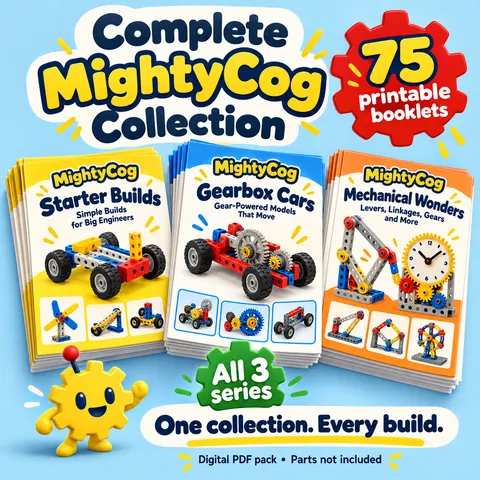
Build one aircraft from each continent, line them up and compare: which has the longest fuselage, the widest wings, the most wheels? The Mi-24 and the Concorde make a good pair because one hovers on a rotor and the other was built for speed. Every aircraft is in the Complete MightyCog booklet collection if you would rather print them all at once.
Interactive: Check yourself. A few quick questions on the ideas in this guide, each with an explanation.
- Why does almost every beam in these aircraft get at least two pins into the slice next to it?
- Which is the smallest build in the aircraft series?
- You balance a model jet on two fingers, then add two extra beams to its nose. Where is the new balance point?
- What makes the propeller of the Spitfire model turn?