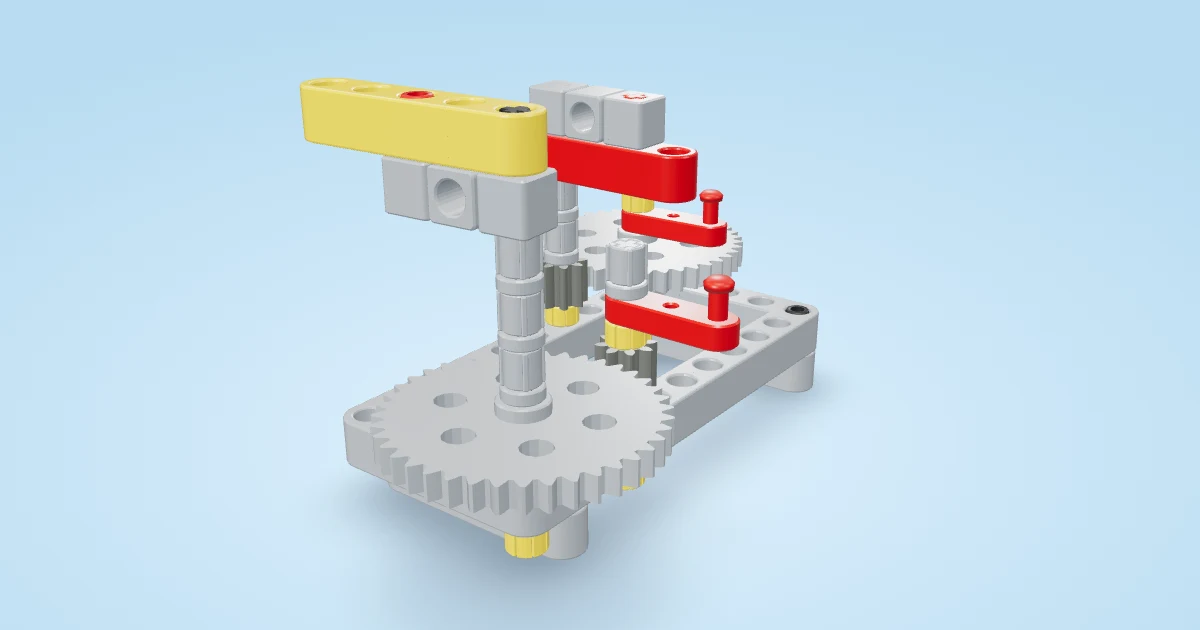
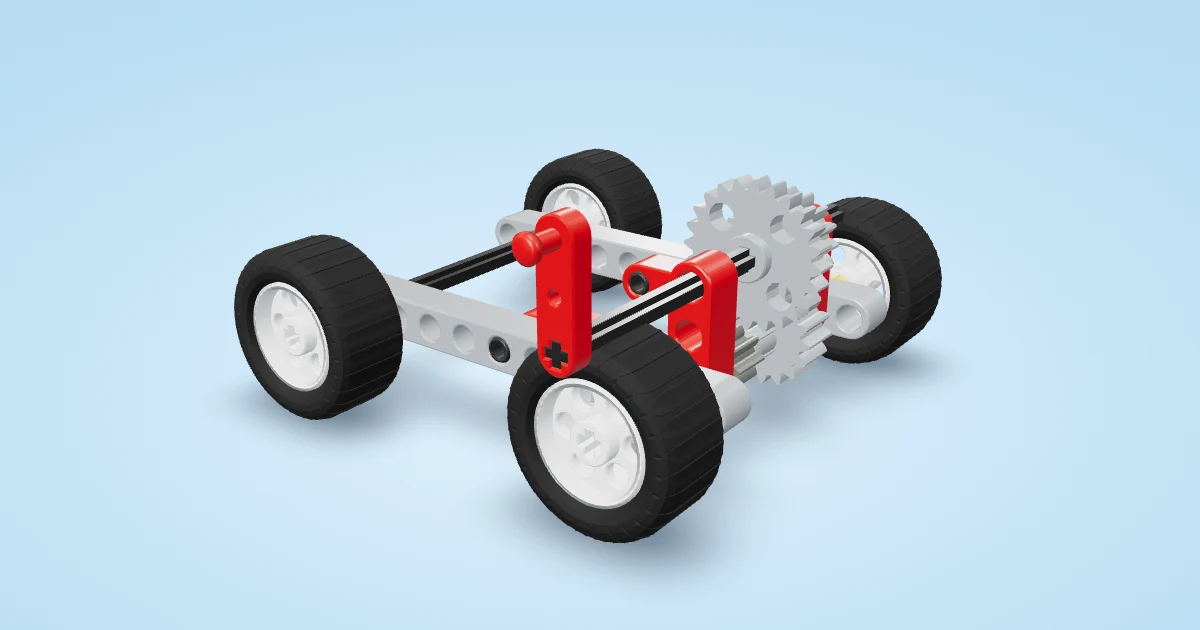
Start with gears that change direction, then count their turns. Next choose between two pairs, engage a pair with a clutch, add a reverse path and combine two selectable reductions. These six existing builds let you practise one new idea at a time. Read each model's prerequisites and parts checklist before choosing it.
You can explore the turn-count exercises on this page before assembling the larger cars. The animated guides show construction and the intended motion. Record your own physical model's observations when you build one. Keep input direction, measurement method and the reference marks consistent between trials.
1. Find which way the last gear turns
Open Gear Friends. Name the gear you turn the input and the last gear the output. Predict whether the first and third gears rotate the same way. Watch the middle gear and follow one mesh at a time.
A pair of external gears turns in opposite directions. A second mesh reverses direction again. Mark a tooth on the input and output, rotate slowly and explain the result before going on. The gear guide gives the vocabulary for the teeth that transmit motion.
2. Count turns before adding a selector
Use Speed Bench to look at the speed relationship. A larger input gear driving a smaller output gear makes the output turn more times per input turn. Write the tooth counts beside the shafts so you can calculate the ratio.
Predict the output count for one complete input rotation. In the lab, compare 16 teeth driving 16 with 24 driving 8. The first pair produces one output turn and the second produces three. Direction reverses in each single mesh. The calculation is ideal and excludes friction and backlash.
Interactive: Gear pair simulator. Pick a driver and a driven gear, turn the input and watch both gears mesh. The ratio, output turns and direction update as you go, and a worksheet checker sets fresh questions.
Explain both the turn count and direction before trying more gears. The gear-ratio worksheet offers extra examples and answers.
3. Select a pair in the sliding cart
Sliding-Gear 2-Speed Cart puts two choices on the same model. Its 16-to-16 pair gives one output turn per input turn. Its 24-to-8 pair gives three. Follow the engaged pair from the crank to the wheel axle.
Stop turning before moving the selector. Look at which teeth overlap in the selected position. Predict the output turn count, then make one slow input turn. In your record, distinguish input turns from how far the car travels. Wheel size connects axle turns to travel, while losses and grip affect the physical result.
Try the shifter below and compare the two settings. The two-speed test explains how to compare a model on a fixed surface.
Interactive: Two-speed gearbox shifter. Shift between the two gears of a real build, turn the input and compare wheel turns with ideal relative turning effort.
4. Engage a gear with a driving ring
In Clutch-Gear 2-Speed Car, follow the selector to the driving ring. Find the selected gear and trace the connection to the axle. Predict which path carries the input before watching the operating motion.
A gear can turn freely around an axle until an engagement makes it transmit rotation to that axle. Compare that with sliding a meshing pair into position. The clutch explanation helps identify the selected connection. Keep the mechanism still while changing a physical model's setting.
5. Keep the input fixed and reverse the output
Reverse-Gear Truck adds a direction question. Turn the input the same way in both settings. Predict the wheel direction by counting the external gear meshes in the selected route.
An additional mesh reverses the direction again. Use arrows drawn on paper beside the shafts and follow them through the path. Count turns separately from direction. A car moving backwards does not by itself tell you its ratio.
6. Combine stages for three speeds
Three-Speed Car puts two selectable stages in series. Each can give a threefold reduction or direct speed. Both reductions together give a ninefold reduction. One reduction and one direct stage give a threefold reduction. Both direct stages give direct speed.
| First stage | Second stage | Ideal output turns per input turn |
|---|---|---|
| Threefold reduction | Threefold reduction | One ninth |
| Threefold reduction | Direct | One third |
| Direct | Threefold reduction | One third |
| Direct | Direct | One |
Four selector combinations yield three distinct turn counts. Explain why the two middle rows match. Use several input turns when the output moves slowly, keeping your reference marks visible. The compound-gears explanation shows why stage ratios multiply.
Keep one record for each stage
Write the selected path, input turns, predicted output turns, observed output turns and direction. If prediction and observation differ, inspect which gear is engaged and whether your mark completed a full revolution. Return to the previous stage when you need a simpler setup. Choose your next build from the gear collection after you can explain the current one.
Interactive: Check yourself. A few quick questions on the ideas in this guide, each with an explanation.
- What happens to direction at one external gear mesh?
- How many output turns does a 24-tooth input driving an 8-tooth output produce per input turn?
- Why do four selector combinations produce three speeds in the final car?