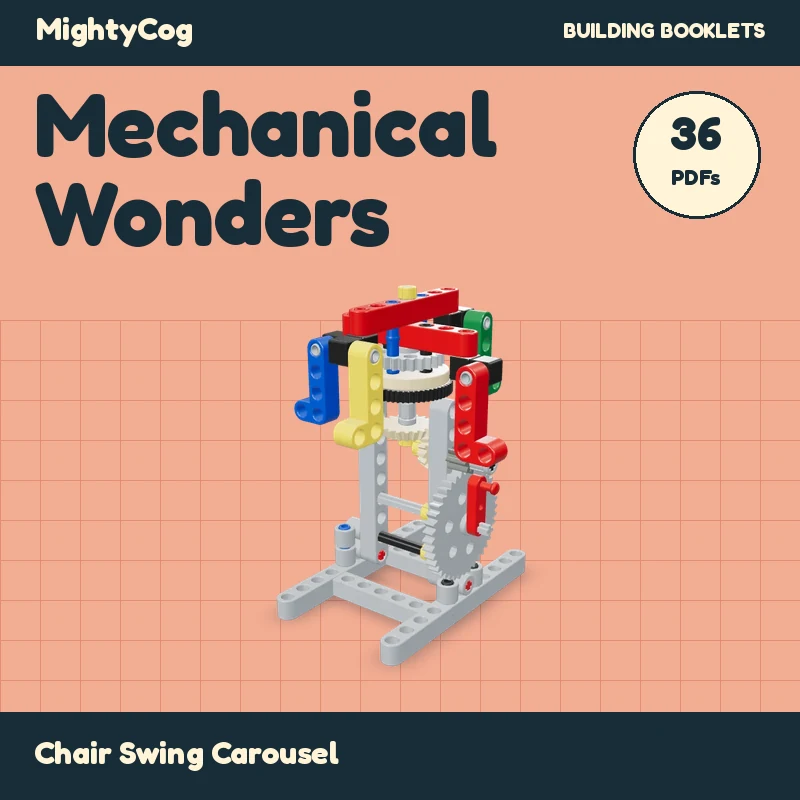
If you want a Technic-style build that rewards an adult’s patience, pick a mechanism with a story: something that solved a real problem, like James Watt’s sun-and-planet gear, a clock escapement, or the south-pointing chariot. The six below are level 4 or 5 builds of 35 to 75 minutes each, every one free to follow, and each teaches one idea you can explain to someone else afterwards.
Use the planner first to see how they fit your week. It reads each build’s own time estimate, step count and part count.
Interactive: Sitting planner. Six level 4–5 mechanism builds with their own time estimates, step counts and part counts. Set your minutes per sitting to see how many sittings each takes, and answer five predict-then-check questions.
1. Sun-and-Planet Beam Engine
The problem: a beam engine rocks up and down, but factories needed shafts that turn. Wikipedia’s sun and planet gear article says it was invented by William Murdoch, an employee of Boulton and Watt, patented by James Watt in October 1781, and designed to get round the crank patent held by James Pickard. Watt went back to the ordinary crank once the patent rights had expired.
A gear fixed to the bottom of the connecting rod (the planet) rolls round a gear on the flywheel shaft (the sun). Because the planet can’t spin, the sun turns more than once per stroke: with equal gears, twice per double stroke of the beam.
The Sun-and-Planet Beam Engine (level 4, about 50 minutes) uses a 24-tooth planet pinned to the rod and an 8-tooth sun, so the flywheels turn 1 + 24 ÷ 8 = 4 times per pump. The coin puzzle inside planetary gears explains where the extra turn comes from.
2. Spring Escapement Clock
A spring released all at once spins everything in a flash. A clock needs the energy out a little at a time, and that is the escapement’s job. The Spring Escapement Clock (level 4, about 50 minutes) takes its energy from a pull-back motor’s spring. Its escape wheel is a big gear with two pins, and the pendulum carries a frame with two pins of its own, the pallets, so a wheel pin always rests against one pallet. What stops the escape wheel between releases goes through it step by step.
3. South-Pointing Chariot
Push it anywhere and its pointer keeps facing the same way, with no magnet. When a cart turns, the outer wheel rolls further than the inner one; a differential measures that difference and turns the pointer back by the same amount. It only works if the gear sizes match the wheel size and the distance between the wheels. The South-Pointing Chariot is the only level 5 build here, at about 75 minutes. The south-pointing chariot’s history covers the ancient Chinese originals.
4. Sun-Earth-Moon Orrery
The quickest of the six, at about 35 minutes. On the Sun-Earth-Moon Orrery the Sun gear is locked to the base, so the Earth’s gear rolls round it and the Earth spins by itself, 2⅔ times per trip round the Sun, with the Moon in tow. It pairs well with the beam engine: the same planetary rolling, used the other way round.
5. Klann Walking Spider
A machine that walks instead of rolling, on one motor. Each leg of the Klann Walking Spider (level 4, about 60 minutes) is a crank-driven linkage whose foot traces a D shape: a flat stroke along the floor that pushes the body forward, then a lift back through the air. The build credits the engineer Joe Klann. How linkages make walking legs lets you trace the foot path yourself.
6. Crank Excavator Arm
Real excavators move with hydraulic cylinders. The Crank Excavator Arm (level 4, about 50 minutes) uses worm gears instead: one handle turns a worm on the turntable to swing the whole top round, a crank turns a second worm to lift the boom, the stick has a stiff joint you set by hand, and the bucket swings freely to scoop and dump. How an excavator works maps each part onto the real machine.
Making the evenings go well
- Sort first. Parts sorted by type are quicker to find mid-step. How to sort and store parts explains why type beats colour.
- Stop at a natural break. End a sitting when a sub-assembly is finished, not halfway through a step.
- Check busy steps twice. In a step that adds many parts, compare your model with the picture before going on. The planner shows which builds pack the most parts into each step.
- Know your pins. Friction pins hold; smooth pins let things turn. Which pin to use explains the colours.
Check yourself
Interactive: Check yourself. A few quick questions on the ideas in this guide, each with an explanation.
- Why did Watt’s engines use a sun-and-planet gear instead of a crank?
- With equal sun and planet gears, how many turns does the shaft make per double stroke of the beam?
- What does the escapement in a clock do?
- What lets a south-pointing chariot keep its pointer aimed one way?