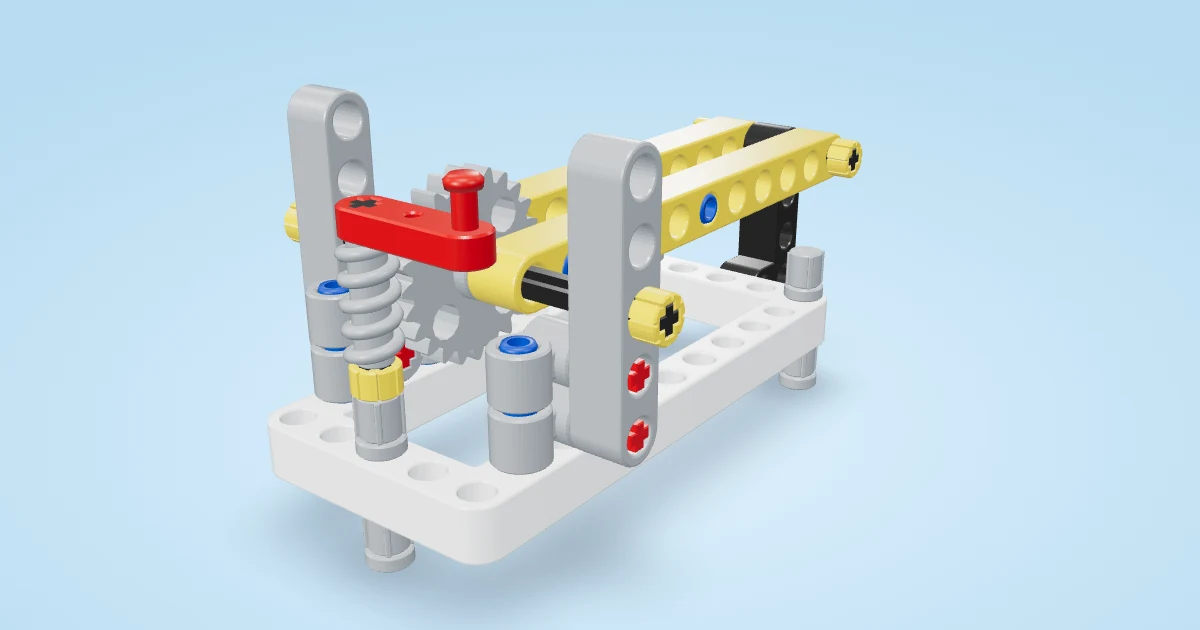
An oscillating fan turns its head from side to side with the same motor that spins its blades. The motor shaft drives the blades directly, and a gear on that shaft also drives a very slow gearbox. On the slow gear sits a small crank, and a link joins the crank to the fan’s base. As the crank goes round, the link pushes and pulls, and because the base can’t move, the head has to rock instead. Spinning becomes swinging.
Our Oscillating Fan (level 3, 53 parts, 18 steps, about 40 minutes) rebuilds that trick in Technic-style parts, small enough that you can watch every piece move.
How does one motor do two jobs?
In the build, an M motor lies on a 5×7 frame that forms the fan’s head. A 7-long axle from the motor carries a worm gear and, at the front, a 24-tooth gear with two 5-hole beams pinned on as blades. So the blades spin at motor speed.
The worm meshes with a 24-tooth gear on a short upright axle. A worm moves its gear on by one tooth each turn, so the upright axle turns once for every 24 motor turns. Real fans do the same: a teardown of a desk fan from the University of Texas describes the swing being driven by the blade motor “with a smaller speed and greater torque due to the gear ratios”. The worm gear post explains why a worm is such a strong reduction.
How does the crank make the head swing?
Under the head, the same upright axle carries a tan 24-tooth gear with a pin one hole from its middle: that is the crank. A red 5-hole beam joins the crank pin to a pin in the 10th hole of the base’s back side. The head itself sits on a turntable, pinned into a hub gear on the turntable’s axle, so the whole head can turn. The turntable idea page shows how the top turns while the bottom stays still.
The link keeps the crank pin a fixed distance from the base pin. As the crank goes round, the only way to keep that distance is for the whole head to turn a little one way, then back. Engineers call this a crank-rocker: four pivots (the turntable, the crank’s axle, the crank pin and the base pin) where one link goes all the way round and another rocks. The walking legs post uses the same family of linkages to make legs step.
How wide does it sweep?
Solving the linkage from the build’s hole positions gives a swing of about 34° in all, about 17° each way. That matches the build file’s own estimate of roughly 16° each way. Try changing the crank, the link and the base pin in the lab, predicting first each time:
Interactive: Fan sweep lab. The Oscillating Fan from above: one motor, a worm and a crank-and-link make the head rock. Change the crank, the link beam or the base pin and predict how wide the fan sweeps, which way it points and how long a sweep takes. Six challenges.
The lab shows a useful split. The crank sets how wide the fan sweeps: move the pin 2 holes out and the swing roughly doubles, to about 69°. The link length and base pin mostly set where the sweep is centred: a 6-hole link pushes the middle of the sweep round by about 18° but only widens it a little. One what-if, a 2-hole crank with a 4-hole link and the base pin in hole 11, jams: the crank can’t get all the way round. These what-ifs come from the maths only; we haven’t built them, so some may hit other parts.
How long does one sweep take?
One crank turn is one sweep there and back, so a sweep takes 24 motor turns. The M motor turns at up to 405 rpm with no load, so the quickest possible sweep is 24 ÷ 405 of a minute, about 3.6 seconds. The real fan is slower, because the motor has the blades and the head to push. Time ten sweeps and divide by ten to get yours.
Questions to try on the real build
The build’s play ideas make good fair tests:
- Flip the battery box switch. The blades spin the other way. Does the head still swing? (It should: the crank goes round either way, so the head rocks through the same angles in the opposite order.)
- Move the base pin one hole along. Predict with the lab first, then mark the two ends of the sweep on a sheet of paper under the fan and measure.
- Feel the breeze. Stand in front, then off to one side. Does the air reach you all the time, or in pulses as the head sweeps past?
For each base pin hole, write the lab’s predicted swing, your measured swing and the seconds per sweep.
| Base pin | Lab swing | Measured | Sweep (s) |
|---|---|---|---|
| Hole 9 | |||
| Hole 10 | |||
| Hole 11 |
The measured columns are blank on purpose: we haven’t measured them. Hole 10 is how the fan is built.
How real fans switch the swing off
Many desk fans have a knob on the motor housing that switches the swing on and off while the blades keep spinning. The University of Texas teardown describes oscillation starting “once the pin is pressed down and the gears come in contact with each other”: the knob joins or separates the slow gears from the motor. Our build has no such knob. The nearest thing is lifting the link off its base pin: the crank keeps turning, but it no longer drives the head.
Where it fits
The Oscillating Fan’s build page lists three builds to try first: the Spinning Radar, which turns a dish on a turntable with an M motor, the Worm-Gear Crane and the Lazy-Tongs Grabber. For a different crank-and-rocker question, see why a rocker can return faster. The Oscillating Fan is in the Mechanical Wonders booklet pack, and its booklet is free on the build page.
Interactive: Check yourself. A few quick questions on the ideas in this guide, each with an explanation.
- How many motors does it take to spin the blades and swing the head of the Oscillating Fan?
- Why is there a worm gear on the motor axle?
- Which change makes the fan sweep a wider angle?
- What does moving the base pin or changing the link length mostly change?