🚂 Sun-and-Planet Beam Engine: step-by-step build
James Watt's steam-engine trick: a gear that never spins makes the flywheel turn four times per pump!
Over 200 years ago James Watt built steam engines with a giant rocking beam. He needed to turn the up-and-down pumping into round-and-round turning for factory wheels — but someone else owned the idea of a crank! So Watt invented the sun-and-planet gear: a gear fixed to the bottom of the rod (the planet) rolls round a gear on the flywheel shaft (the sun). The planet never spins, but by rolling round the sun it makes the sun turn several times for every pump. The heavy flywheels keep everything turning smoothly between pushes.
- Level 4 of 5 (tricky)
- About 50 minutes
- 17 steps, 49 parts
- Powered by: Hand-crank
- Series: Mechanical Wonders
What you will learn
- Sun & Planet Gears: Gears that orbit around another gear.
- Linkages: Beams joined by pins change one motion into another.
- Flywheel: A heavy spinning wheel stores energy.
- Triangles Are Strong: A triangle cannot be squished — a square can.
Build these first
- 🌬️ Bevel-Gear Windmill: Turn the handwheel at the bottom — the sails spin at the top! (level 3 of 5, about 25 minutes, 16 steps)
 🏗️ Worm-Gear Crane: Crank the worm gear to lift the boom — then let go. It stays up by itself! (level 3 of 5, about 30 minutes, 15 steps)
Parts you need
- 1 × Open frame 5×11
- 4 × Blue long pin
- 6 × Split pin block
- 6 × Red axle-pin
- 2 × Beam 13
- 1 × Beam 15
- 2 × Grey pin (smooth)
- 2 × Beam 7
- 1 × Axle 7
- 3 × Bush
- 7 × Black pin (grippy)
- 1 × Beam 5
- 1 × Axle 9
- 2 × Half bush
- 1 × Tan axle-pin
- 1 × Cross block
- 1 × Open frame 5×7
- 1 × Beam 3
- 1 × Axle 4
- 1 × Dark medium gear (24 teeth)
- 1 × Axle 11
- 1 × Tiny gear (8 teeth)
- 2 × Big tyre wheel
Steps
- Lay the white 5×11 frame flat, pointing sideways.
- Post feet: push blue long pins up into the 3rd and 5th holes of the frame's far side and slide two split pin blocks down onto them, one on top of the other.
- Do the same on the near side.
- Push a red axle pin into each of the four blocks, pointing out.
- Stand a 13-hole post on each pair of red pins, just outside the frame.
- Walking beam: take the 15-hole beam. It rocks, so it is a moving part.
- Push a smooth grey pin into each end hole of the beam and hang a 7-hole rod on each by its top hole.
- Lower the beam between the posts. Hold a bush on each side of its middle hole and push the 7-long pivot axle through post, bush, beam, bush, post.
- Push black pins up into the first two holes of the frame's near side and press a 5-hole beam flat onto them, sticking out to the left.
- Push a tall guide axle up through the beam's end hole and slide a half bush down onto the beam to lock it.
- Push a tan axle-pin into the bottom hole of the left rod (smooth end in the rod, so it can pivot), then slide a cross block onto the guide and onto the axle end. This is the piston.
- Bearing feet: push black pins up into the 6th, 8th, 9th and 11th holes of the frame's near side.
- Press a split pin block onto each pair of pins and push a red axle pin into each, pointing out.
- Stand the 5×7 frame up on the two red pins (its 1st and 4th bottom holes): the bearing wall.
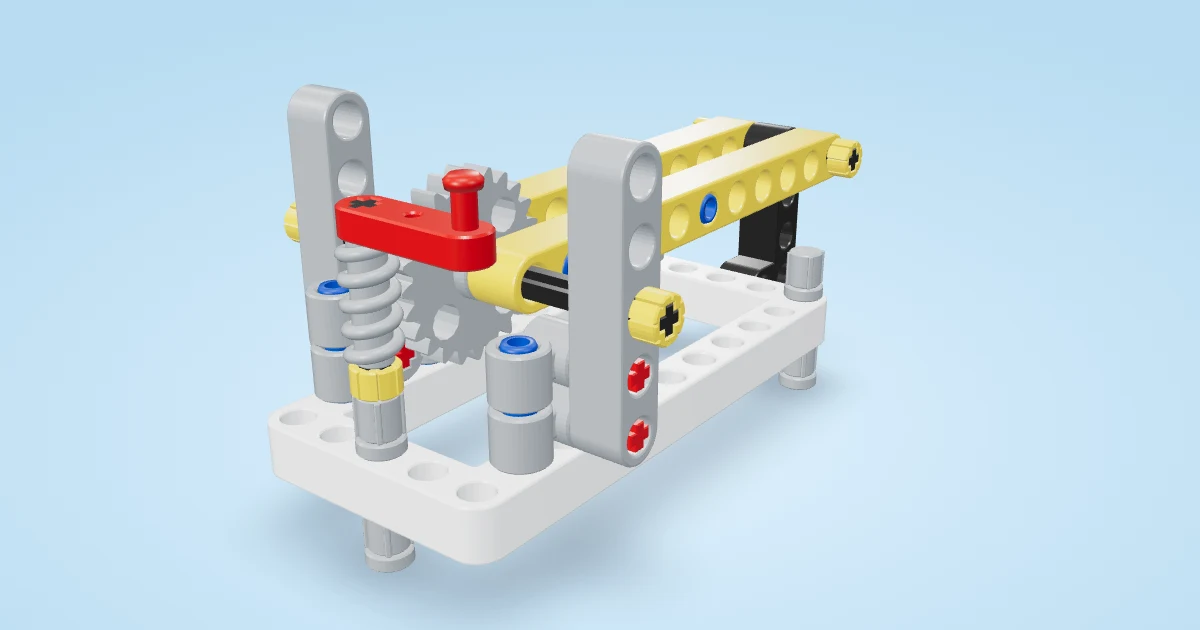
- PLANET: hold a 3-hole link behind the right rod and the dark 24-tooth gear in front of it. Push a 4-long axle from the back through the link's 3rd hole, the rod's bottom hole and the gear, and a black pin through the rod into a small hole of the gear.
- SUN: hold the tiny 8-tooth gear under the planet with a bush behind it, and push the long flywheel shaft from the front through the bearing wall, the sun gear, the bush and the link's 1st hole. The bush and the wall keep the sun gear from sliding. Put a half bush on the back end of the planet axle.
- Slide two big wheels onto the shaft as flywheels.
Play time
Pump the piston up and down and count the flywheel turns. Mark the planet gear with a sticker — does it ever turn upside down? Give the flywheel a spin and watch the beam nod by itself.
Real-world inspiration
Sun and planet gear — https://en.wikipedia.org/wiki/Sun_and_planet_gear ; LEGO mechanism demos listed by Doctor Engine — https://doctorengine.info/post/lego-technic-mechanical-principles/