Here is a puzzle to try before reading on. You are winding up a castle drawbridge. Is it hardest to lift at the start, halfway up, or near the top?
The answer is at the start. A drawbridge is a lever turning about its hinge, and its weight pulls with leverage equal to the weight times the sideways distance from the hinge to the deck’s centre. Lying flat, that distance is as big as it gets. As the deck rises, its centre moves in over the hinge, so it gets easier, and straight up it takes no effort at all. Real drawbridges add a chain from high above the gate or a counterweight to deal with that hard start.
Our model
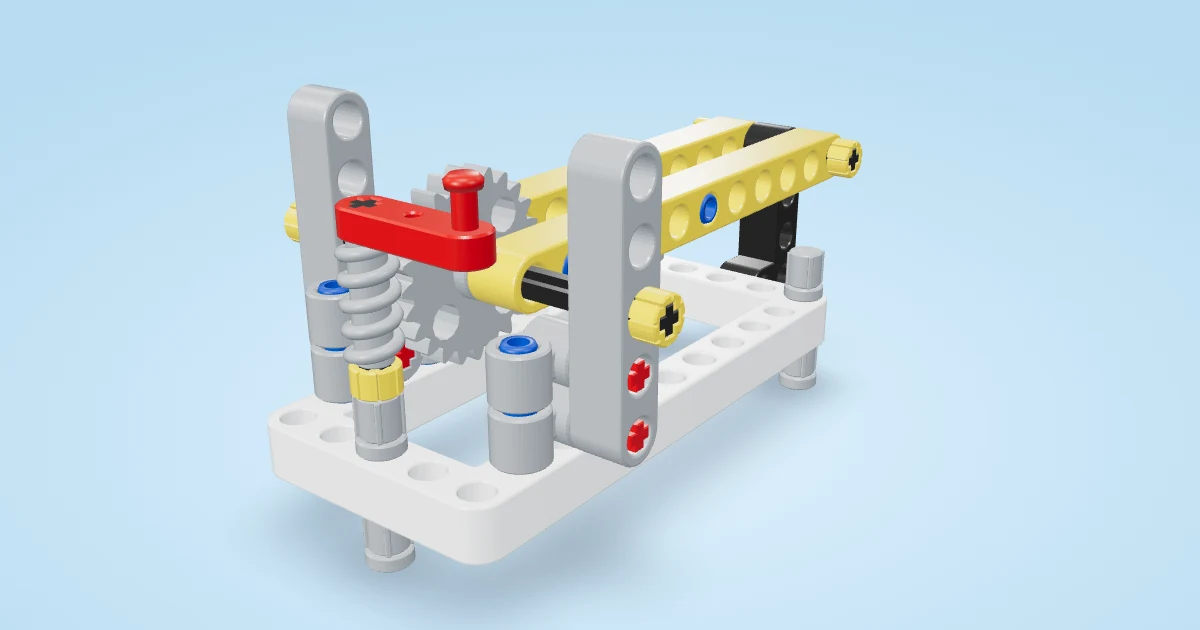
Our Castle Drawbridge is a level 2 build of 15 steps that takes about 30 minutes. Two 5×7 frames make the towers. The deck is a white 5×11 frame with a 5-hole foot beam at its far end, reaching 11 holes from its hinge. Two cross blocks clamp the deck to a 10-long hinge axle, so when the axle turns, the bridge turns with it.
The axle carries a 24-tooth gear, and a worm on the crank shaft drives it. One crank turn moves the gear by one tooth, so 24 crank turns would take the bridge all the way round. The build’s animation raises it to 70°. Its only prerequisite is the Worm-Gear Crane, which uses the same worm drive.
Solving the puzzle
The twist needed to hold the deck is its weight times the sideways distance from the hinge to its centre of weight. Raise it by an angle and that sideways distance shrinks by the cosine of the angle:
| Deck angle | Sideways distance (and twist) |
|---|---|
| 0° (flat) | 100% |
| 30° | 87% |
| 45° | 71% |
| 60° | 50% |
| 90° (upright) | 0% |
The first part of the lift is the hard part. After 60° it is less than half as hard as at the start. Upright, the deck’s weight pulls straight down through the hinge and turns nothing.
The same weight × distance rule balances a lifting arm in the counterweight post. It explains the Parking Barrier Gate too, and the hinge here is the pivot of a class 2 lever once a chain lifts the tip.
Real castles pulled from above
Wikipedia’s drawbridge article says castle drawbridges were usually raised by ropes or chains running to a windlass in a chamber above the gate passage. The bridge was hinged at the gatehouse threshold, and when raised it lay flat against the gate as one more barrier.
A chain from above adds a second puzzle: how high should it start? The chain only turns the deck by its distance from the hinge. Anchor it as high above the hinge as the deck is long, and to start lifting a flat deck it must pull about 0.71 times the deck’s weight. Anchor it half as high, and the chain is flatter and closer to the hinge, so the pull rises to about 1.1 times the weight. A high anchor is easier.
The article adds that only a very light bridge could be raised that way without a counterweight. By the 14th century, castles used lifting arms called gaffs, lying above and parallel to the deck and chained to it, with counterweights on their inner ends.
Try the angles and the chain yourself:
Interactive: Drawbridge lifting lab. Raise the Castle Drawbridge’s deck and see how hard it is to hold at each angle and how many crank turns it takes, then try a castle-style chain from above the gate and move its anchor. Five predict-then-check challenges.
Counterweights on modern bridges
A modern drawbridge that tips up is a bascule bridge. Wikipedia’s article on them says the name comes from the French for a balance scale, and that a counterweight balances the span all the way up, so it takes relatively little energy to open. London’s Tower Bridge opened in 1894. Each of its two leaves weighs about 1,070 tons with ballast and paving, and swings through 82°. The leaves are counterbalanced so they can be raised in five minutes, originally by water pressure stored in six hydraulic accumulators and pumped by steam engines.
Why our model doesn’t need a counterweight
Our model has no counterweight. The worm holds the bridge instead. The deck’s weight tries to turn the 24-tooth gear, but a gear can’t drive a worm backwards, so the bridge stays wherever you stop. The worm gear post explains why. The cost is speed: the worm makes you crank about 4.7 turns to reach 70°.
Try this on the real model
- Raise the bridge, let go halfway and push down on the deck with a finger. Does it move?
- Count crank turns from flat to upright. Does your count match 24 ÷ 4 = 6 for a quarter turn?
- Crank with two fingers on the very end of the handle, then with a finger close to the shaft. Which feels harder at the start, and does it still feel hard near the top?
Interactive: Check yourself. A few quick questions on the ideas in this guide, each with an explanation.
- When is a drawbridge that is turned at its hinge hardest to hold?
- At 60°, how hard is the deck to hold compared with lying flat?
- Why were castle lifting chains anchored high above the gate?
- Why does the model bridge stay up when you let go of the crank?