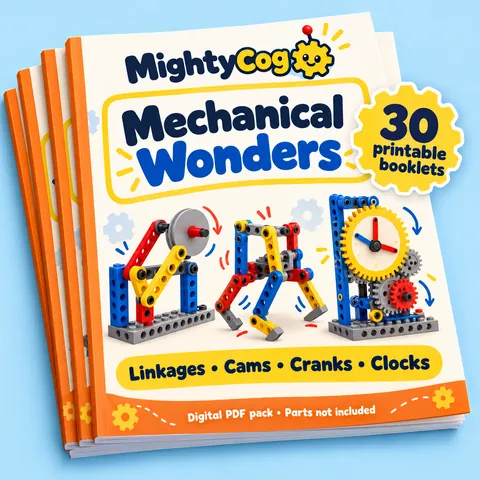
Simple machines are the building blocks of every other machine: levers, wheels and axles, pulleys, wedges, screws and inclined planes. These mechanisms are often introduced as a list to learn. They stick much better as things to build and play with, and the most fun ones are the machines that turn one kind of motion into another: a turn into a tap, a drop into a throw, a spin into a push.
Here are six builds, easiest first, that each show one idea clearly. None of them needs a motor except the last one.
1. The lever: Balance See-Saw
A lever is a bar that turns on a pivot. Push one end down and the other end goes up. Move the pivot and the push gets easier or harder.
Balance See-Saw is a see-saw that is also a scale, built in about 12 minutes. Put one gear on one side and two gears on the other: can one gear beat two? (Yes, if it sits further from the middle.) The levers page explains the three kinds of lever with everyday examples: see-saws, wheelbarrows and tweezers.
Try the see-saw below before you build it. Hang gears on the holes, predict which way the beam will go, then let go. The challenges finish with the build's own puzzle: one gear against two.
Interactive: Lever balance simulator. Hang gear weights on holes 1–7 each side of a see-saw pivot, predict whether it tips left, right or balances, then let go. Eight scored challenges include the Balance See-Saw puzzle: can one gear beat two?
2. The counterweight: Parking Barrier Gate
A counterweight is a heavy weight on the far side of a pivot that balances the load, so lifting it feels easy. Lift bridges, cranes and lifts all use one.
Parking Barrier Gate has a long striped barrier that lifts with a tiny turn thanks to a heavy counterweight. Take the counterweight off and try again: suddenly it's hard work. The counterweight page has a tipping test to try.
3. The cam: Woodpecker Automaton
A cam is a bumpy wheel. As it turns, the bump lifts whatever rests on it (the follower) and then lets it drop. It turns round-and-round motion into up-and-down motion.
Woodpecker Automaton pecks every time the cam comes round. Something has to bring the follower back down, so its bird has a heavy tail: gravity keeps the tail resting on the cam. It takes about 20 minutes and is a memorable demonstration because it looks alive. Ask: how could you make it peck twice per turn? (Two bumps on the cam.) More on the cams page.
4. The linkage: Lazy-Tongs Grabber
A linkage is a set of bars joined by pins that move together. Change the shape of one part and the whole thing moves.
Lazy-Tongs Grabber is a scissor grabber: squeeze the handles and the far end shoots out and grips. It's the same idea as a scissor lift or an extending mirror. See the linkages page.
5. Stored energy and a big lever: Counterweight Trebuchet
A trebuchet combines a lever and a counterweight. A heavy weight drops on the short end, the long arm whips up, and the throw happens at the tip.
Counterweight Trebuchet throws a small bush across the room when the heavy battery box drops. It's a level 3 build that takes about 40 minutes. Try a heavier weight, then a longer arm, and measure each throw with tape on the floor. (Please aim at cushions, not people or pets.)
6. The crank: Twin-Piston Engine
A crank turns round-and-round motion into back-and-forth motion, or the other way round. It's how a car engine turns the pistons' push into a spinning shaft, and how an old steam train drives its wheels.
Twin-Piston Engine shows two pistons racing up and down in turn, driven by a motor. Turn it slowly by hand first and watch where each piston stops. The crank and slider page explains what's happening.
How to use these at home or in class
- Build, then break it on purpose. Remove the counterweight, move the pivot, add a bump to the cam. Changing one thing at a time is how builders discover what each part does.
- Name it after they feel it. Say "that's a lever" once they have pushed it, not before.
- Find it in the house. After each build, hunt for the same machine at home: door handles (levers), a garlic press (lever), a music box (cam), a bike pedal (crank).
Where to go next
The machines collection has 30 more: clocks, a Ferris wheel, a walking spider and a planetarium. For a structured course, the Blueprint Lab Forces & Motion mission at the Intermediate level uses the Balance See-Saw for lessons on balanced forces and predicting the tip, with lesson plans and rubrics.
Interactive: Check yourself. A few quick questions on the ideas in this guide, each with an explanation.
- One gear hangs 6 holes from the pivot. Two gears hang on the other side, 2 and 4 holes out. What happens?
- Two gears sit on hole 3. Where does one gear need to go on the other side to balance them?
- Why does the Parking Barrier Gate lift easily with its counterweight on?
- What does a cam do in the Woodpecker Automaton?