🌪️ Ripcord Top Launcher: step-by-step build
Pull a toothed rack and watch two gear stages turn the top.
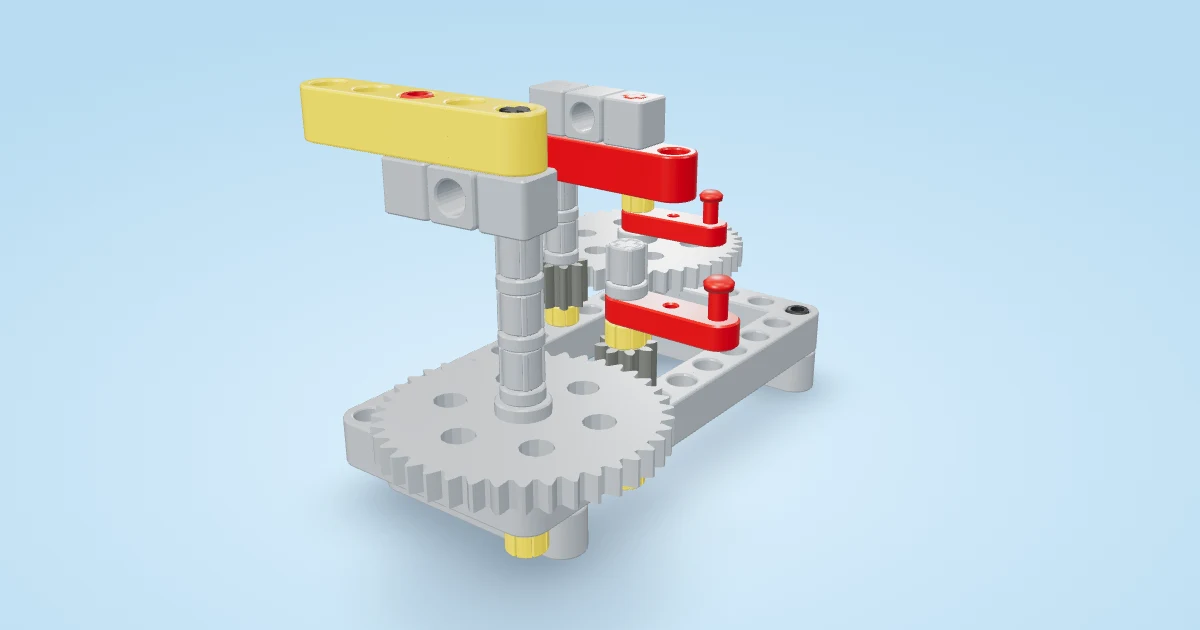
A straight pull can produce rotation. The toothed ripcord turns an 8-tooth pinion and the 40-tooth gear on its shared shaft. That large gear drives an 8-tooth gear on the supported top shaft. Ideally, one input-shaft turn gives five top-shaft turns in the opposite direction. Explore the engaged pull-and-return in the animation. A release or freely spinning top is not demonstrated or physically tested here.
- Level 2 of 5 (easy)
- About 20 minutes
- 18 steps, 47 parts
- Powered by: Hand-crank
- Series: Mechanical Wonders
What you will learn
- Rack & Pinion Steering: A gear rolling on a straight rack slides it sideways.
- Gear Ratio: Fast or Slow: A big gear turning a small gear makes it spin faster.
- Flywheel: A heavy spinning wheel stores energy.
- Gears: Gears are wheels with teeth that push each other round.
- Frames: A frame is a ready-made strong rectangle.
Build these first
 🧪 Gear Speed Lab: Two cranks, two gear pairs: one makes things FAST, one makes things STRONG. (level 2 of 5, about 20 minutes, 13 steps)
Parts you need
- 1 × Open frame 5×7
- 4 × Blue long pin
- 4 × Cross block
- 4 × Long pin-axle block
- 3 × Axle 5
- 12 × Black pin (grippy)
- 4 × Beam 7
- 5 × Half bush
- 2 × Tiny gear (8 teeth)
- 1 × Giant gear (40 teeth)
- 1 × Axle 12
- 2 × Bush
- 1 × Yellow-hub wheel
- 1 × Beam 15
- 2 × Steering rack
Steps
- Hold the 5×7 frame flat. This is the launcher body.
- Push a blue long pin down into the 2nd and 4th holes of the back end, so they poke out underneath. Push a cross block onto the bottom of each, its cross hole pointing out behind.
- Hold a long pin-axle block at each back corner and slide a 5-long axle through them and both cross blocks.
- Do the same at the front end: two blue long pins and two cross blocks, cross holes pointing out to the front…
- …then two long pin-axle blocks and a 5-long axle.
- Back left leg: push two black pins backwards into a pin-axle block and press a 7-hole beam onto them by its 4th and 6th holes.
- Back right leg: two black pins and a 7-hole beam.
- Front left leg: two black pins, pointing forwards, and a 7-hole beam.
- Front right leg: two black pins and a 7-hole beam. Four stiff legs!
- Push a 5-long axle up through the back corner hole, with a half bush under the frame so it cannot slide out. Slide a tiny 8-tooth gear down onto the frame.
- Slide a half bush above the tiny gear, then add the giant 40-tooth gear and lock it with another half bush. The spacer keeps the giant gear clear of the ripcord pins.
- Make the top: push a 12-long axle up through the middle hole of the side. Slide a half bush and a full bush onto it so they rest on the frame and support the top shaft.
- Slide a tiny 8-tooth gear onto the top shaft so it meshes with the giant gear, then add the upper bush. Turn the whole top shaft slightly so its teeth fit into the giant gear’s gaps.
- Finish the top: slide the heavy yellow wheel and a half bush tip onto the bottom of the axle.
- Ripcord: lay the 15-hole handle flat.
- Put the two toothed racks on the handle, teeth facing the tiny gear.
- Pin the racks to the handle with four black pins. Your ripcord is ready!
- Slide the ripcord sideways along the back of the launcher until the middle of its right-hand toothed section is beside the tiny gear. Rotate the whole pinion shaft slightly so teeth fit into gaps; keep the animated four-module stroke within this toothed section.
Play time
Hold the launcher steady and slowly pull and return the rack within one toothed section. Compare the input-shaft and top-shaft angles. Which direction does each turn? Free release and spinning duration are not tested by this animation.
Real-world inspiration
Ripcord top launchers and Brick Experiment Channel spin tests — https://brickexperimentchannel.wordpress.com/2022/11/14/20-mechanical-principles-machine/