🌀 Coasting Wheel Bench: step-by-step build
Spin a retained tabletop wheel gently, then measure how it slows down.
A wheel keeps turning after your hand leaves it, but friction gradually removes its rotational energy. This original direct-drive bench isolates coasting from gearing, motors and vehicle motion. A pinned bridge supports a vertical shaft at the centre of a wide four-foot frame. Inspired by Brick Experiment Channel’s hand-powered spinning demonstration; this is not their high-speed machine or its instructions.
- Level 2 of 5 (easy)
- About 15 minutes
- 8 steps, 21 parts
- Powered by: Hand-crank
- Series: Starter Builds
What you will learn
- Flywheel: A heavy spinning wheel stores energy.
- Friction: Friction is the rubbing force that slows things down.
- Axles: An axle is a cross-shaped rod — anything on it turns together.
- Frames: A frame is a ready-made strong rectangle.
- Bushes & Spacers: Bushes stop things sliding off an axle.
- Pins: Grippy or Smooth: Pins join beams together — some hold tight, some let things swing.
Build these first
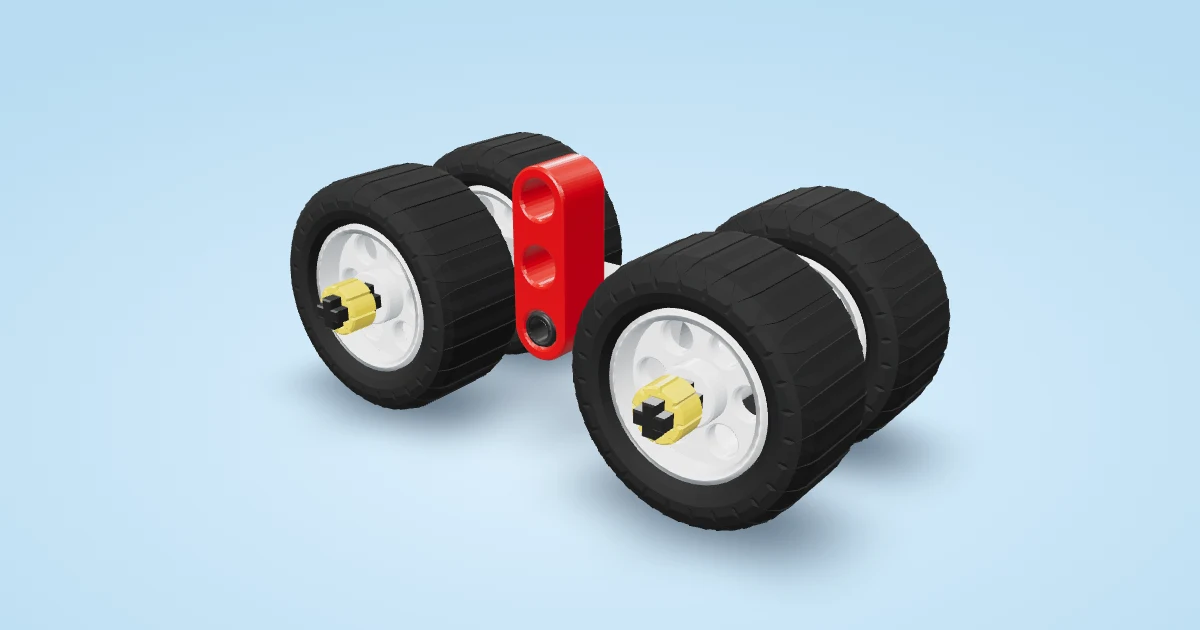 🚗 Tiny Roller: Your very first rolling car — only 13 pieces! (level 1 of 5, about 5 minutes, 6 steps)
Parts you need
- 1 × Open frame 5×11
- 4 × Axle 3
- 8 × Bush
- 2 × Black pin (grippy)
- 1 × Beam 5
- 1 × Axle 6
- 3 × Half bush
- 1 × Yellow-hub wheel
Steps
- Lay the 5×11 frame flat. Its four corner holes will hold the feet; the middle holes on its long sides will hold a bridge.
- Fit a 3-module axle through this corner. Hold it while fitting a full bush underneath as a foot and another full bush above as a retainer. Repeat at all four corners; the feet must rest level.
- Fit a 3-module axle through this corner. Hold it while fitting a full bush underneath as a foot and another full bush above as a retainer. Repeat at all four corners; the feet must rest level.
- Fit a 3-module axle through this corner. Hold it while fitting a full bush underneath as a foot and another full bush above as a retainer. Repeat at all four corners; the feet must rest level.
- Fit a 3-module axle through this corner. Hold it while fitting a full bush underneath as a foot and another full bush above as a retainer. Repeat at all four corners; the feet must rest level.
- Push two black friction pins upward through the middle holes of the long sides. Press the end holes of a flat 5-hole beam onto them, across the open centre. Two separated pins keep this bearing bridge rigid.
- Fit a vertical 6-module axle through the bridge’s centre round hole. Hold it while fitting a half bush directly underneath and another directly above. Leave the shaft free to turn, with minimal axial play.
- Slide the yellow-hub wheel down the shaft onto the upper spacer. Add a half bush on top to retain it. The tyre must clear the bridge; do not squeeze the bearing tight.
Play time
Hold the stationary frame on a level table. Add a small removable index mark to the wheel. Give the shaft a gentle finger turn, release it and count revolutions until it stops. Repeat three times, recording your release method and uncertainty. Do not use a drill, motor, string launcher or try to match the source video’s high speed.
Real-world inspiration
Spinning a Lego Wheel Fast BY HAND — Brick Experiment Channel — https://www.youtube.com/watch?v=2xkq0Wp8egM